Author

admin

Browsing

A Senate Republican renewed his push to federalize Washington, D.C., following an attack on a former Department of Government Efficiency (DOGE) staffer and President Donald Trump’s threat to put the District under federal control.

Sen. Mike Lee, R-Utah, has long called for control of Washington to fall under Congress, going so far as to introduce the Bringing Oversight to Washington and Safety to Every Resident (BOWSER) Act, named after D.C. Mayor Muriel Bowser, in an effort to combat crime in the District.

The bill, which Lee introduced alongside Rep. Andy Ogles, R-Tenn., has not made it out of committee since being dropped in February. But Trump’s highlight of an attack against former DOGE staffer Edward Coristine, also known as ‘Big Balls,’ has resurrected the discussion.

‘The Constitution already federalizes D.C.,’ Lee said on X. ‘We just need Congress to do its job — and reassert its lawmaking power over our nation’s capital city. My bill, the BOWSER Act, would do that.’

Fox News Digital reached out to Lee for further comment.

Lee’s bill would effectively repeal the District of Columbia Home Rule Act, a law passed in the 1970s that established a city council and mayor and reduced the amount of oversight that Congress has over the city and its affairs.

But calls have grown by lawmakers over the years to increase Congress’ oversight of the city, largely centered on concerns over increased crime and criticisms of attempts to rewrite the District’s criminal code.

And Trump jumped into the discourse, too, threatening that if ‘D.C. doesn’t get its act together, and quickly, we will have no choice but to take Federal control of the City.’

‘Perhaps it should have been done a long time ago, then this incredible young man, and so many others, would not have had to go through the horrors of Violent Crime,’ Trump said on his social media platform, Truth Social. ‘If this continues, I am going to exert my powers, and FEDERALIZE this City.’

Fox News reached out to Bowser’s office for comment but did not immediately hear back.

Zack Smith, a senior legal fellow at The Heritage Foundation and a former prosecutor, told Fox News Digital that in the past, the D.C. council has pushed ‘policies that have made it much more difficult for law enforcement, for prosecutors, to do their jobs and keep citizens safe.’

Bowser and the D.C. Council have, for several years, worked to update the District’s criminal code. However, changes to the code that would have severely lowered sentencing for a variety of crimes that were at first vetoed by Bowser were on the precipice of becoming law before Congress and former President Joe Biden overrode the reforms.

Smith noted that Congress still has the authority to legislate the District, meaning that lawmakers and the federal government are ‘still the backstop,’ and that both Trump and Lee were right to call for a ‘reevaluation of the District’s status.’

‘That’s why Congress was able to step in and overturn that proposed radical rewrite of the Criminal Code,’ he said. ‘And so what the BOWSER Act would actually do, if it repeals home rule, it would essentially change the way the local D.C. government functions. It might involve Congress and the Federal Government taking a more direct role.’

‘I think there is broad and in some ways bipartisan consensus that the current system in D.C. is not working as it should,’ he continued. 

This post appeared first on FOX NEWS

OpenAI’s ChatGPT is one of the latest technological breakthroughs in the artificial intelligence space. But what is ChatGPT, and can you invest in OpenAI?

This emerging technology is representative of a niche subsector of the AI industry known as generative AI — systems that can generate text, images or sounds in response to prompts given by users.

Precedence Research expects the global AI market to grow at a compound annual growth rate (CAGR) of 19.2 percent to reach US$3.68 trillion by 2034. Just how much of an impact OpenAI’s ChatGPT will have on this space is hard to predict, but Fortune Business Insights estimates that the total market revenue of generative AI will see a CAGR of 39.6 percent through 2032, increasing from US$67.18 billion last year to US$967.65 billion in 2032.

In September 2024, Reuters reported that OpenAI was planning a restructuring from a non-profit to a for-profit company in order to make it ‘more attractive to investors.’ However, after encountering backlash and potential legal conflicts, in May 2025 OpenAI’s management decided to remain a non-profit while still converting its for-profit arm into a public benefit corporation.

OpenAI completed a new round of funding totaling US$40 billion in late March 2025 projected to bring its valuation to US$300 billion. Japanese multinational investment firm SoftBank made up 75 percent of the funding, while Microsoft (NASDAQ:MSFT), and investment firms Coatue Management, Altimeter Capital and Thrive Capital also took part in the raise.

The US Department of Defense (DoD) awarded a US$200 million contract to OpenAI in June 2025 to provide the DoD with artificial intelligence tools for addressing national security challenges, including cyber defense and warfare.

In this article

    What is OpenAI’s ChatGPT?

    Created by San Francisco-based tech lab OpenAI, ChatGPT is a generative AI software application that uses a machine learning technique called reinforcement learning from human feedback (RLHF) to emulate human-written conversations based on a large range of user prompts. This kind of software is better known as an AI chatbot.

    ChatGPT learns language by training on texts gleaned from across the internet, including online encyclopedias, books, academic journals, news sites and blogs. Based on this training, the AI chatbot generates text by making predictions about which words (or tokens) can be strung together to produce the most suitable response.

    More than a million people engaged with ChatGPT within the first week of its launch for free public testing on November 30, 2022. The introduction of ChatGPT quickly ushered in a new era in the tech industry.

    Based on this success, OpenAI created a more powerful version of the ChatGPT system called GPT-4, which was released in March 2023. This iteration of ChatGPT can accept visual inputs, is much more precise and can display a higher level of expertise in various subjects. Because of this, GPT-4 can describe images in vivid detail and ace standardized tests.

    Unlike its predecessor, GPT-4 doesn’t have any time limits on what information it can access; however, AI researcher and professor Dr. Oren Etzioni has said that the chatbot is still terrible at discussing the future and generating new ideas. It also hasn’t lost its tendency to deliver incorrect information with too high a degree of confidence.

    Further improving on its product, in May 2024 OpenAI launched Chat GPT-4o, with the o standing for omni. OpenAI describes GPT-4o as ‘a step towards much more natural human-computer interaction—it accepts as input any combination of text, audio, image, and video and generates any combination of text, audio, and image outputs.’

    This version has done away with the lagging response time afflicting GPT-4. This proves especially helpful for producing immediate translations during conversations between speakers of different languages. It also allows users to interrupt the chatbot to pose a new query to modify responses.

    More recently, in December 2024, OpenAI introduced ChatGPT Pro subscriptions targeting engineers and academics. For US$200 monthly, users have nearly unlimited access to all ChatGPT models and tools.

    The ChatGPT 3.5 and ChatGPT-4 platforms are free to use, and can be accessed via the web. Those with an iPhone or iPad can also use ChatGPT through an app, and an Android version launched in July 2023. OpenAI also launched a paid subscription, ChatGPT Plus for business use, in August 2023. ChatGPT Plus gives users access to GPT-4 and the newest iteration GPT-4o.

    What is the Stargate Project?

    The Stargate Project is an AI joint venture focused on building new AI infrastructure in the US through US$500 billion in investments. It was announced on January 21, 2025.

    Stargate’s initial funding is coming from OpenAI, SoftBank, Oracle (NYSE:ORCL) and UAE-based technology fund MGX. In addition to OpenAI and Oracle, Stargate’s technology partners include Microsoft, NVIDIA, and British semiconductor and software design company Arm Holdings (NASDAQ:ARM).

    Newly re-elected US President Trump unveiled Stargate during a press conference at the White House highlighting the importance of investment in US AI infrastructure. During the announcement, OpenAI’s Altman, Oracle co-founder Larry Ellison and Softbank CEO Masayoshi Son credited President Trump’s return to office as a major catalyst in making Stargate a reality. The construction of data centers for the Stargate Project are already underway in Texas, according to Ellison.

    How much has Microsoft invested in OpenAI?

    Ascannio / Shutterstock

    Over the years, Microsoft has reportedly invested nearly US$14 billion in OpenAI to help the small tech firm create its ultra-powerful AI chatbot.

    As for how Microsoft could benefit from its investment in OpenAI, OpenAI officially licensed its technologies to Microsoft in 2020 in a then-exclusive partnership. Indeed, Pitchbook has described the deal as an “unprecedented milestone” for generative AI technology. Since then, Microsoft has made good use of OpenAI’s technology in developing new advancement in its Azure cloud computing business.

    However, the relationship between the two has changed in recent months.

    Notably, Microsoft is not a financier of the Stargate Project joint venture, and is instead just described as a technology partner. According to OpenAI’s press release, the new joint venture builds on its existing partnership with Microsoft.

    Microsoft’s lack of a funding role in Stargate led some to wonder if the trillion-dollar tech firm had soured on its relationship with OpenAI. This conclusion was understandable given reports that Microsoft refused to make a bigger contribution than the US$750 million it invested during the OpenAI US$6.6 billion funding round in October 2024.

    Additionally, Microsoft changed the contract between the two companies and is no longer the exclusive cloud provider for OpenAI, but has the right of first refusal for deals the AI firm may make with other cloud companies.

    As Bloomberg technology reporter Dina Bass explained, Microsoft stands to benefit from its role as a technology partner without having to invest a dime into the project.

    “Microsoft views the revised contract with OpenAI as advantageous, according to people familiar with the company’s thinking. The software giant retains its share of OpenAI’s revenue and is the largest investor in a company that may now become even more valuable — though the size of that stake could change as the startup works to restructure as a for-profit,” wrote Bass. “And Microsoft also still has access to OpenAI models, even if they’re trained in a data center funded by Softbank or Oracle.”

    Yet, there are reports that Microsoft and OpenAI’s relationship is on the brink of a big breakup. The tech giant has been pushing for a much larger percentage of OpenAI’s revenues than the 20 percent it currently enjoys. According to the Wall Street Journal, OpenAI is considering making antitrust complaints about Microsoft to regulators even though the two companies are still undergoing high level discussions about the future of the partnership.

    Elon Musk’s position on OpenAI

    DIA TV / Shutterstock

    OpenAI was founded in 2015 by Altman, its current CEO, as well as Tesla (NASDAQ:TSLA) CEO Elon Musk and other big-name investors, such as venture capitalist Peter Thiel and LinkedIn co-founder Reid Hoffman. Musk left his position on OpenAI’s board of directors in 2018 to focus on Tesla and its pursuit of autonomous vehicle technology.

    A few days after ChatGPT became available for public testing, Musk took to X, formerly known as Twitter, to say, “ChatGPT is scary good. We are not far from dangerously strong AI.” That same day, he announced that X had shut the door on OpenAI’s access to its database so it could no longer use it for RLHF training.

    His reason: “OpenAI was started as open-source & non-profit. Neither are still true.”

    Furthering his feud with OpenAI, Musk filed a lawsuit against the company in March 2024 for an alleged breach of contract. The crux of his complaint was that OpenAI has broken the ‘founding agreement’ made between the founders (Altman, Greg Brockman and himself) that the company would remain a non-profit. Altman and OpenAI have denied there was such an agreement and that Musk was keen on an eventual for-profit structure.

    Musk dropped the lawsuit three months later without giving a reason, reported Reuters. The day before he dropped the lawsuit, he reacted to the news that Apple (NASDAQ:AAPL) is partnering with OpenAI to incorporate ChatGPT with Apple devices. On X, Musk declared, ‘If Apple integrates OpenAI at the OS (operating system) level, then Apple devices will be banned at my companies. That is an unacceptable security violation.” It should be noted that OpenAI has said queries completed on Apple devices will not be stored by OpenAI. By August 2024, Musk had resumed his litigation in federal court.

    It seems that the US government also has questions about the restructuring of the private company and the involvement of tech giant Microsoft, as reported by Bloomberg. In early January 2025, the Financial Press also reported the Federal Trade Commission (FTC) has raised questions about the potential anti-trust violations in the newly emerging AI technology space arising from Microsoft’s partnership with and investments in OpenAI.

    Of course, Musk took to X to weigh in on the Stargate Project, suggesting OpenAI and its partners don’t actually have the US$500 million they’ve pledged to invest. Sam Altman was quick to reply, telling Musk he’s mistaken and inviting him to visit their data center under construction in Texas.

    However, Musk is not alone in his skepticism. For example, Atreides Management Chief Investment Office Gavin Baker also questioned the deal on X. “Stargate is a great name but the $500b is a ridiculous number and no one should take it seriously,” Baker wrote, backing up his statement by explaining the financial positions of each of the partners. “Nowhere close to $500b. Everyone should just start issuing press releases for $1 trillion AI projects.”

    OpenAI criticisms and lawsuits

    While ChatGPT has served as a major step forward in generative AI technology, there are many technical and ethical concerns with the program that have emerged since it launched, including fears over job destruction and targeted disinformation campaigns.

    Accuracy of information in ChatGPT’s answers is not guaranteed. Its selection of which words to string together are actually predictions — not as fallible as mere guesses, but still fallible. Even the 4.0 version is “still is not fully reliable (it “hallucinates” facts and makes reasoning errors),” says the company, which emphasizes that users should exercise caution when employing the technology.

    Indeed, ChatGPT’s failings can have dangerous real-life consequences. Among other negative applications, the tech can be used to spread misinformation, carry out phishing email scams or write malicious code.

    There’s also the fear among teachers that the technology is leading to an unwelcome rise in academic dishonesty, with students using ChatGPT to write essays or complete their homework.

    “Teachers and school administrators have been scrambling to catch students using the tool to cheat, and they are fretting about the havoc ChatGPT could wreak on their lesson plans,” writes New York Times tech columnist Kevin Roose.

    Many lawsuits against OpenAI have emerged as well. Multiple news outlets, including the the New York Times, have launched copyright lawsuits against OpenAI, and some of the plaintiffs are also seeking damages from the private tech firm’s very public partner Microsoft.

    Additionally, the Authors Guild, which represents a group of prominent authors, launched a class-action lawsuit against OpenAI that is calling for a licensing system that would allow authors to opt out of having their books used to train AI, and would require AI companies to pay for the material they do use.

    In October, OpenAI researcher Suchir Balaji blew the whistle on the company, reporting that the firm was violating US copyright laws. He died one month later in what was ruled a suicide, but the investigation is still open.

    Cybersecurity risks are also a concern for ChatGPT users, and recent events along these lines add validity to Musk’s warning. For one, in 2024 ChatGPT for macOS was discovered to be breaching Apple’s security rules by storing data as plain text rather than encryption, making it possible for other apps to access.

    What’s the future of OpenAI and ChatGPT?

    What about the long-term goals for OpenAI and ChatGPT? For most of the tech leaders in this space, the end game is artificial general intelligence (AGI) — a system that can perform any function the human brain can, including self-teaching, abstract thinking and understanding cause and effect.

    As uptake increases, AI technology is taking over the role of humans and will likely continue doing so in a number of fields, from content creation and customer service to transcription and translation services, and even in graphic design, software engineering and paralegal fields.

    In addition to Microsoft’s use of the ChatGPT technology as part of Copilot, other companies are working with OpenAI to incorporate the technology into their platforms, including Canva, Duolingo (NASDAQ:DUOL), Expedia Group (NASDAQ:EXPE), Intercom, Salesforce (NASDAQ:CRM), Stripe, Tinder, Upwork (NASDAQ:UPWK) and Visa (NYSE:V).

    For 2025, OpenAI is focusing on developing agentic AI capabilities into its ChatGPT platform. Agentic AI, a part of the evolution towards AGI, involves AI systems and models that can act autonomously and complete tasks without much human guidance. Early in January, OpenAI announced the rollout of new task features for ChatGPT Pro, Plus and Teams users. While still in the beta stage, these features allow users to schedule future tasks to be completed by ChatGPT, such as a weekly news brief or reminders about important meetings.

    OpenAI first debuted its foray into agentic AI in September 2024 with the introduction of ChatGPT o1, stating ‘We’ve developed a new series of AI models designed to spend more time thinking before they respond.’ The release of the next iterations of this model, ChatGPT o3 mini and o4 mini happened in the first half of 2025.

    The recent release of Chinese startup DeepSeek’s AI assistant may present a problem for OpenAI and the US tech industry as a whole. In what tech gurus like Marc Andreesen call AI’s Sputnik moment, DeepSeek unseated ChatGPT as the most downloaded free app in the Apple App Store, at reportedly a fraction of the cost. For reference, in 1957 the Soviets launched Sputnik, the earth’s first artificial satellite, beating out the United States and sparking a Cold War space exploration race between the two nations.

    The DeepSeek launch set off a significant sell off in technology stocks on January 27, 2025, especially among the Magnificent Seven members, including NVIDIA, Microsoft and Alphabet (NASDAQ:GOOGL).

    When will OpenAI go public?

    OpenAI stock is not currently publicly traded, and following the May 2025 decision to remain a non-profit, there are no signs of an on initial public offering (IPO) in the works for 2025. For now, investors can gain exposure through related tech companies discussed below.

    Which stocks will benefit the most from AI chatbot technology?

    Other than companies directly tied to generative AI technology, which stocks are likely to get a boost from generative AI advancements?

    There are several verticals in the tech industry with indirect exposure to AI chatbot technology, such as semiconductors, network equipment providers, cloud providers, central processing unit manufacturers and internet of things.

    Some of the publicly traded companies in these verticals include:

      You can also take a look back at the market with our AI Market 2024 Year-End Review and AI Market Update: Q2 2025 in Review, or read projections for AI this year in our AI Market Forecast: 3 Top Trends that will Affect AI in 2025. Generative AI is also a major theme in the Top 10 Emerging Technologies to Watch.

      FAQs for investing in OpenAI and ChatGPT

      How is OpenAI funded?

      OpenAI raised US$57.9 billion over 11 funding rounds from 2016 to March 2025.

      Top investors include technology investment firm Thrive Capital, venture capital firm Andreessen Horowitz and revolutionary technology investment firm Founders Fund.

      What is the market value of ChatGPT/OpenAI?

      OpenAI has a market valuation of US$300 billion as of June 2025. The company’s annualized revenue reached the US$10 billion mark in June 2025, up from the US$5.5 billion achieved in December 2024.

      Does ChatGPT use NVIDIA chips?

      ChatGPT’s distributed computing infrastructure depends upon powerful servers with multiple graphics processing units (GPUs). High-performance NVIDIA GPU chips are preferred for this application as they also provide excellent Compute Unified Device Architecture support.

      What is DeepSeek?

      DeepSeek is a Chinese AI company that launched new AI-driven, open-source language models known as DeepSeek-V3 and DeepSeek-R1 into the market in January 2025. Reuters reports that ‘the training of DeepSeek-V3 required less than $6 million worth of computing power from Nvidia H800 chips.’

      DeepSeek-R1 is designed to compete with the performance of OpenAI-o1 across math, code, and reasoning tasks.

      Can ChatGPT make stock predictions?

      A University of Florida study from 2023 highlighted the potential for advanced language models such as ChatGPT to accurately predict movements in the stock market using sentiment analysis.

      During the course of the study, ChatGPT outperformed traditional sentiment analysis methods, and the finance professors conducting the research concluded that “incorporating advanced language models into the investment decision-making process can yield more accurate predictions and enhance the performance of quantitative trading strategies.”

      When to expect ChatGPT 5?

      In June 2025, during an OpenAI podcast Sam Altman responded with, ‘Probably some time this summer,’ when asked about when the market can expect to see ChatGPT-5.

      Previously, OpenAI filed a trademark application for ChatGPT-5 in mid-July 2023, which hinted that the next iteration of the generative AI technology is currently under development. There were rumors the company planned to complete training for ChatGPT-5 by the end of 2023, but this did not materialize. PC Guide noted in April 2024 that Sam Altman had teased an “amazing new model this year’ in an interview on the Lex Fridman podcast.

      In November 2024, Altman confirmed that ChatGPT-5 wouldn’t likely hit the market until later in 2025 as the company switched its focus to ChatGPT o1 and its successors.

      Securities Disclosure: I, Melissa Pistilli, hold no direct investment interest in any company mentioned in this article.

      This post appeared first on investingnews.com

      Veteran Democratic operative Anita Dunn will be on Capitol Hill on Thursday for a closed-door interview with House Oversight Committee investigators.

      She is the tenth former White House official to appear before the panel’s lawyers, as Committee Chair James Comer, R-Ky., probes whether former President Joe Biden’s inner circle worked to cover up signs of mental decline in the elderly leader – and whether executive actions signed via autopen were done without his awareness.

      Dunn is appearing voluntarily before the committee’s lawyers for a transcribed interview. It’s expected to begin around 10 a.m. and will likely last several hours into the afternoon.

      Three of the 10 former Biden administration officials who have appeared so far have come under subpoena, and each pleaded the Fifth Amendment to avoid answering material questions.

      Appearing voluntarily does not give people the ability to invoke the constitutional right against self-incrimination, but it’s possible Dunn will give House investigators little to work with.

      The six former White House aides who appeared voluntarily before her have all defended Biden’s mental acuity and ability to serve as president, sources said, even as some, like ex-Chief of Staff Ron Klain, have conceded the 82-year-old’s age has worn on him over time.

      Dunn, like those who appeared before her, has known Biden for years.

      She’s been a key player in Democratic communications and public relations strategies for decades, and reportedly was a central figure in Biden’s messaging strategy both at the White House and during his short-lived 2024 campaign.

      ‘She’s running everything,’ one unnamed White House advisor told CNN in June 2023 while discussing Biden’s re-election bid.

      A January 2023 report by NBC News described Dunn and her husband, former Obama administration White House counsel Robert Bauer, as central figures in Biden’s orbit. Bauer also reportedly served as Biden’s personal lawyer.

      ‘If it’s a room of five people, Anita and Bob are two of them,’ an unnamed former White House aide told the outlet.

      Dunn was also a central figure amid the fallout after Biden’s disastrous June 2024 debate against then-candidate Donald Trump.

      NBC News reported in July 2024 that Biden family members discussed whether he should fire Dunn and Bauer, though White House chief of staff Jeff Zients dismissed the reports as ‘unfounded and insulting rumors’ in a statement to the outlet at the time.

      Dunn served as White House communications director under former President Barack Obama, and Biden brought her onto his 2020 campaign to help with his own communications strategy.

      She also served as senior advisor to the president for communications in the Biden White House before playing a key role in his 2024 campaign.

      Comer wrote in his letter summoning Dunn, ‘You served as former President Biden’s ‘most senior communications adviser.’ Former President Biden confided in you extensively over the past decade.’

      ‘The Committee seeks to understand your observations of former President Biden’s mental acuity and health as one of his closest advisors. If White House staff carried out a strategy lasting months or even years to hide the chief executive’s condition—or to perform his duties—Congress may need to consider a legislative response,’ Comer wrote.

      This post appeared first on FOX NEWS

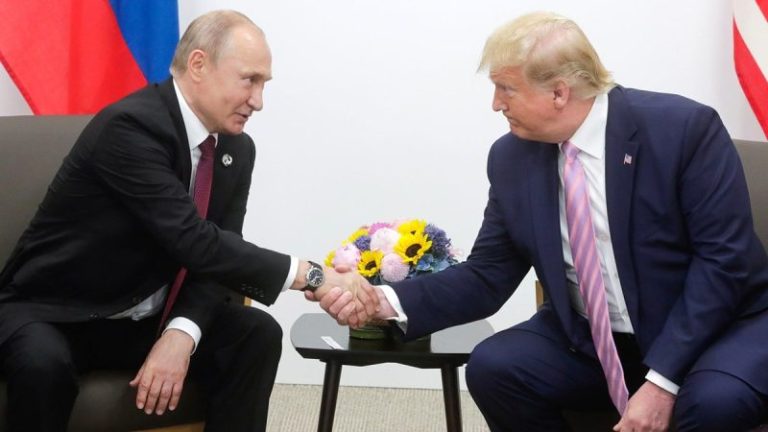
      President Donald Trump and Russian President Vladimir Putin appear to be on track to soon have their first meeting since Trump took office for his second term earlier this year.

      ‘As for Ukrainian affairs directly, at the suggestion of the American side, an agreement was agreed upon in principle to hold a bilateral meeting at the highest level in the coming days, that is, a meeting of Presidents Vladimir Putin and Donald Trump,’ aide to the Russian president Yuri Ushakov noted, according to a Russian to English translation by Google Translate of Ushakov’s comments.

      ‘As for the option of a trilateral meeting, which for some reason was discussed yesterday in Washington, this option was simply mentioned by the American representative during the meeting in the Kremlin. But this option was not specifically discussed. The Russian side left this option completely, without comment,’ Ushakov noted. ‘We propose first of all to focus on preparing a bilateral meeting with D. Trump and we believe that the main thing is for this meeting to be successful and productive.’

      Fox News Digital reached out to the White House for comment early on Thursday morning.

      The potential meeting would come as President Trump has been trying to help broker an end to the years-long Russia-Ukraine war.

      ‘My Special Envoy, Steve Witkoff, just had a highly productive meeting with Russian President Vladimir Putin. Great progress was made!’ Trump declared in a Wednesday post on Truth Social. 

      ‘Afterwards, I updated some of our European Allies. Everyone agrees this War must come to a close, and we will work towards that in the days and weeks to come. Thank you for your attention to this matter!’

      White House press secretary Karoline Leavitt noted, ‘As President Trump said earlier today on TRUTH Social, great progress was made during Special Envoy Witkoff’s meeting with President Putin. The Russians expressed their desire to meet with President Trump, and the President is open to meeting with both President Putin and President Zelensky. President Trump wants this brutal war to end.’

      Fox News Channel’s Peter Doocy contributed to this report

      This post appeared first on FOX NEWS

      In a win for Make America Healthy Again (MAHA) advocates, six more states have gotten waivers allowing them to ban soda, candy and other high-sugar junk foods from being purchased through the federally funded, but state-operated Supplemental Nutrition Assistance Program, known as SNAP. 

      The waivers, which amend the statutory definition of eligible food for purchase under SNAP, were granted to West Virginia, Florida, Colorado, Louisiana, Oklahoma and Texas. The new restrictions on what can and cannot be purchased will go into effect in 2026.

      The six new waivers bring the number of states that have sought to restrict SNAP purchases of junk food to 12. The other states who received waivers from the Trump administration earlier this year were Nebraska, Iowa, Indiana, Arkansas, Idaho and Utah.

      ‘For years, SNAP has used taxpayer dollars to fund soda and candy, products that fuel America’s diabetes and chronic disease epidemics,’ Health Secretary Robert F. Kennedy Jr. said

      ‘These waivers help put real food back at the center of the program and empower states to lead the charge in protecting public health.’

      Agriculture Secretary Brooke Rollins has praised the historic efforts that states, mostly those with Republican leadership, have made to help improve the health and nutrition assistance provided through SNAP. 

      On average, 42 million low-income Americans receive food stamp assistance each month, including one in five American children under 17, according to a report from the Trump administration released earlier this year.

      ‘It is incredible to see so many states take action at this critical moment in our nation’s history and do something to begin to address chronic health problems,’ Rollins said after the latest announcement of new waivers. ‘President Trump has changed the status quo, and the entire Cabinet is taking action to Make America Healthy Again. … These state waivers promote healthier options for families in need.’

      Of the 12 states that have been granted SNAP waivers thus far, all of them will restrict SNAP funds from being used to purchase sugary drinks, including soda, while at least eight of the states have indicated plans to ban SNAP funds for candy purchases. Some states, such as Florida, Louisiana and Nebraska, will explicitly ban energy drinks as well, while others, like Arkansas, have indicated drinks with less than 50% natural juice will be banned. 

      ABC News medical correspondent Darien Sutton argued the move, although pushed as an effort to improve health outcomes, lacks evidence.

      ‘There’s no evidence that taking away access to soda will actually fight these conditions,’ he said, according to ABC News. ‘Sugar is one of those culprits that you always have to be mindful of.’ 

      Sutton pointed out that U.S. dietary guidelines recommend that men do not have more than 35 grams of sugar per day, while women are told to limit it to 25 grams per day. 

      This post appeared first on FOX NEWS

      Apple CEO Tim Cook will join President Donald Trump on Wednesday for an event touting what the White House calls a new $100 billion investment commitment by the tech giant in the U.S.

      The announcement in the Oval Office, set for 4:30 p.m. ET, includes Apple’s commitment to a new “American Manufacturing Program,” a White House official confirmed to CNBC.

      With the new pledge, Apple’s total investment in the U.S. over the next four years now totals $600 billion, the official said.

      Bloomberg first reported Apple’s new investment pledge earlier Wednesday.

      The meeting comes as Trump has pushed Apple to make its products in America — a feat that experts say would jack up prices by hundreds of dollars, if it can even be done at all.

      Most of Apple’s flagship iPhones have been manufactured in China, though the company is moving some of its production to India.

      Trump has complained about that plan. “We’re not interested in you building in India, India can take care of themselves … we want you to build here,” Trump said he told Cook in May.

      On Wednesday, Trump announced he will double the U.S. tariff rate on Indian goods to 50%. Trump said he was raising the tariff because of India continuing to purchase Russian oil.

      Trump had exempted smartphones, chips and other tech products from his early April “reciprocal” tariff plan, which slapped a 10% baseline duty on nearly the entire world and set significantly higher rates for dozens of individual countries.

      That exemption still applied as of this week, following Trump’s executive order tweaking U.S. tariffs on a slew of countries.

      And it appears to remain intact in Trump’s latest order ratcheting up tariffs on imports from India.

      Apple declined CNBC’s request for comment.

      CNBC’s Steve Kovach contributed to this report.

      This post appeared first on NBC NEWS

      Fox Corp. will launch its direct-to-consumer streaming service, Fox One, on Aug. 21, ahead of the NFL season, the company said Tuesday.

      The new streaming service will cost $19.99 per month, and pay TV subscribers will receive access for free, said CEO Lachlan Murdoch during the company’s earnings call.

      Fox One will host the entirety of the Fox TV portfolio — namely, live sports such as NFL and MLB that appear on its broadcast network, as well as news programming from its Fox News and Fox Business cable TV networks.

      Fox airs NFL games on Sundays during the regular season, which kicks off this year on September 4. The broadcast network also airs MLB postseason games, as well as college football, which also takes place in the fall.

      However, the streaming service won’t offer any exclusive or original content, Murdoch said, adding that much of its costs will come from overhead, marketing and technology. This is in contrast to most of Fox’s competitors, which spend on additional sports rights and other content exclusive to streaming.

      “It’s important to remember that our subscriber expectations or aspirations for Fox One are modest,” Murdoch said.

      The company has been slower than its peers to jump into the streaming game. While it already has the Fox Nation service and Tubi, a free, ad-supported streaming app, it has yet to offer its full content slate in a direct-to-consumer offering.

      Murdoch previously said the cost for the service would be “healthy and not a discounted price,” in an effort to avoid further disrupting the pay TV bundle, which has suffered continued customer losses.

      Fox’s portfolio is mainly made up of sports and news content since it sold its entertainment assets to Disney in 2019. This has shielded Fox from some of the cord-cutting headwinds that have affected its media peers in recent years.

      On Tuesday, Murdoch reiterated that the company will be looking to bundle Fox One with other streaming services. However, he said the company will be careful on that front, similarly so as not to cause further damage to the pay TV ecosystem.

      He said Fox is mindful of two factors when it comes to bundling. First, to offer the consumer a convenient package of its content, and potentially valuable bundles. And second, to keep the service “very focused” on a “targeted audience” of those customers without pay TV subscriptions.

      “Sometimes those two things conflict with each other. So we want to be very targeted, but we also want to make it easy for our consumers and our viewers to gain our content, whether it’s in conjunction with other services or not,” Murdoch said.

      Earlier this year, Murdoch told investors that Fox would launch its own answer to streaming after dropping its efforts for the joint sports streaming venture, Venu.

      It will be joined by a new streaming offering from Disney’s ESPN in the coming weeks. While Disney already offers the ESPN+ streaming service, the company will launch a full-service ESPN direct-to-consumer product this fall. Disney earlier said that the app will cost $29.99 a month. Disney reports its quarterly earnings on Wednesday.

      On Tuesday, Fox reported total revenue for its most recent quarter of $3.29 billion, up 6% from the same period last year.

      While the advertising market has been weak for media companies, particularly for content outside of live sports, Fox reported its advertising revenue increased 7%. The company said this was primarily due to growth from Tubi as well as “stronger news ratings and pricing,” despite a drag from the absence of major soccer events as compared to the year-earlier quarter.

      This post appeared first on NBC NEWS

      Questcorp Mining Inc. (CSE: QQQ,OTC:QQCMF) (OTCQB: QQCMF) (FSE: D910) (the ‘Company’ or ‘Questcorp’) is pleased to announce that drilling has commenced on its La Union Project in northwest Sonora, Mexico. This work is being carried out by property vendor and operator Riverside Resources Inc. (TSXV: RRI).

      Highlights

      • Initial drill program is designed to expand known zones of mineralization, test new targets, and explore areas surrounding multiple historical mine workings within the 25 km² project area.
      • Drill program will consist of + 1,500m of diamond core drilling across six holes, each averaging 250m in depth.
      • Drilling to test the carbonate-hosted replacement deposit (CRD) style of mineralization, with gold associated with mantos, chimneys, and along structural zones.
      • Angled drill holes are aimed at cutting perpendicular to stratigraphic targets and some structural targets which is typical in CRD systems
      • Structural features may have served as mineralizing conduits and are key targets in the current drill program.

      The recent exploration work over the past three months by Riverside has improved the understanding of the structural geology and stratigraphy in the Sierra El Viejo, the mountain range immediately to the west of La Union Project. The La Union district lies along the flanks of this range, where these updated interpretations help guide current exploration efforts. The exploration target focus is for a large potential gold discovery that expands from previous smaller scale mine operations on the property. The drill program will begin to test the new concepts and expand past previous mining.

      Saf Dhillon, President & CEO states, ‘Questcorp is proud to be working with John-Mark and his whole team at Riverside in what is a historic moment in the development of this property. The La Union Project has had work conducted on it for decades, including the production of 50,000 ounces of gold itself but, it has never had a drill bit pierce the ground until now!’

      Earlier this year, Questcorp entered into a definitive option agreement with Riverside’s wholly owned subsidiary, RRM Exploracion, S.A.P.I. DE C.V. to acquire a 100% interest in the La Union Project. As part of the agreement, Questcorp issued shares to Riverside, making Riverside a shareholder and aligning both parties’ interests in the Project’s success. With funding provided by Questcorp, an initial C$1,000,000 exploration program is now underway. This marks the first phase of a larger, C$5,500,000 work commitment, contingent on exploration results and Questcorp’s continued participation.

      The Drill Program Targets include more than four different areas, beginning with this early-stage stratigraphic and orientation phase of drilling exploration aimed at evaluating the scale of alteration and indications of a mineralized system. This will be the first drilling ever conducted on most of the targets, despite past mining having occurred in the majority of these areas. The initial program will consist of one to three holes per area, primarily for orientation purposes. Follow-up drilling is planned and can be expanded based on initial results, which will help verify the stratigraphy, lithologies, and structural features allowing for improved modeling and next-stage discovery targeting. The four areas are listed below:

      • Union Main Mine Area – The program will use angled drill holes to test limestone and other carbonate stratigraphic hosts within the Clemente Formation, with the potential to reach the underlying Caborca Formation. These units are considered the primary hosts for replacement-style mineralization.
      • North Union Mine Area – The initial focus of the program will be on testing structural interpretations. Additional drilling is anticipated following this first phase, as results will help guide future drill testing of areas with past mining activity and various structural orientations.
      • Cobre Mine Area – The Clemente Formation is the primary host unit, and structural features combined with areas of past mining provide multiple target zones. Drilling will begin with an initial stratigraphic test hole to help orient around the thickness of the host unit and extend into the lower Caborca Formation, which is also a favorable host for CRD-style mineralization.
      • Central Union Area – Structural targets, as possible mineralization feeder zones, are a key focus in this past mining manto area. There are extensive additional target zones in the area, and this initial orientation drilling will provide vectoring for the next stage of drilling and further study of the Clemente Formation, and possibly into the Caborca Formation as currently interpreted.

      General Overview of La Union Project

      The Project is summarized in a recently published NI 43-101 Technical Report available under Questcorp’s SEDAR+ profile (www.sedarplus.ca). Riverside initially acquired the Project and subsequently consolidated additional inlier mineral claims, building a strong land position. Riverside then advanced the Project through surface access agreements and drill permitting, making it a turn-key exploration opportunity for Questcorp.

      The Project was originally identified through Riverside’s exploration work in the western Sonora Gold Belt, conducted in collaboration with AngloGold Ashanti Limited, Centerra Gold Inc., and Hochschild Mining Plc. Earlier research by Riverside Founder John-Mark Staude also contributed to recognizing the district’s potential. Initial work by members of the Riverside team, drawing on more than two decades of geological compilation and analysis, further confirmed the region as highly prospective.

      At the Project, historical mining by the Penoles Mining Company targeted chimney and manto-style replacement bodies within the upper oxide zones. As a result, the underlying sulfide zones represent immediate and compelling drill targets for further exploration.

      The Project features favorable limestone host rocks, an extensive alteration footprint, and multiple small-scale historical workings, with mineralization styles similar to those at the Hermosa Project in southern Arizona. At Hermosa, South32 is advancing mine development following its acquisition of the project from Arizona Mining. On 15 February 2024, South32’s board approved a US $2.16 billion capital investment to develop the Taylor zinc-lead-silver deposit, representing the largest private mining investment in Southern Arizona’s history. The project is now considered one of the most significant undeveloped base-metal assets in the United States.

      At the La Union Project, immediate drill targets offer the potential for significant-scale discoveries. La Union is well positioned for near-term exploration success, with targets that include both oxide and deeper sulfide mineralization.

      Figure 1. Geologic map with the tenure of the Union internal concession shown in pink. Manto and chimney type CRD targets are shown as red polygons. All mineral tenures on this map comprise the La Union project. The drill program will focus on the Union Mine and areas north of the Union Mine with the initial drill work.

      To view an enhanced version of this graphic, please visit:
      https://images.newsfilecorp.com/files/10197/261433_a2ed3d4fb471dade_001full.jpg

      Figure 2. Cross section looking west with conceptual drill targets and schematic drillhole traces. Assays from Riverside’s sampling of rock dump materials from the two mine areas are labeled in black. Red areas are interpreted as manto and chimney target bodies that are now well defined and drill ready. Assays shown on figures 1 and 2 have been previously released and disclosed as summarized below the geochemical QA/QC and in published NI 43-101 Report that Questcorp published 2025 on Sedar+.

      To view an enhanced version of this graphic, please visit:
      https://images.newsfilecorp.com/files/10197/261433_a2ed3d4fb471dade_002full.jpg

      The La Union Project

      The La Union Project is a carbonate replacement deposit (‘CRD’) project hosted by Neoproterozoic sedimentary rocks (limestones, dolomites, and siliciclastic sediments) overlying crystalline Paleoproterozoic rocks of the Caborca Terrane. The structural setting features high-angle normal faults and low-to-medium-angle thrust faults that sometimes served as mineralization conduits. Mineralization occurs as polymetallic veins, replacement zones (mantos, chimneys), and shear zones with high-grade metal content, as shown in highlight grades of 59.4 grams per metric tonne (g/t) gold, 833 g/t silver, 11% zinc, 5.5% lead, 2.2% copper, along with significant hematite and manganese oxides, consistent with a CRD model (see the technical report entitled ‘NI 43-101 Technical Report on the Union Project, State of Sonora, Mexico’ dated effective May 6, 2025 available under Questcorp’s SEDAR+ profile). These targets also demonstrate intriguing potential for large gold discoveries potentially above an even larger porphyry Cu district potential as the Company’s target concept at this time.

      Questcorp cautions investors that grab samples are selective by nature and not necessarily indicative of similar mineralization on the property.

      The technical and scientific information in this news release has been reviewed and approved by R. Tim Henneberry, P. Geo (BC), a director of the Company and a ‘qualified person’ under National Instrument 43-101 – Standards of Disclosure for Mineral Projects.

      About Questcorp Mining Inc.

      Questcorp Mining Inc. is engaged in the business of the acquisition and exploration of mineral properties in North America, with the objective of locating and developing economic precious and base metals properties of merit. The Company holds an option to acquire an undivided 100% interest in and to mineral claims totaling 1,168.09 hectares comprising the North Island Copper Property, on Vancouver Island, British Columbia, subject to a royalty obligation. The Company also holds an option to acquire an undivided 100% interest in and to mineral claims totaling 2,520.2 hectares comprising the La Union Project located in Sonora, Mexico, subject to a royalty obligation.

      Contact Information

      Questcorp Mining Corp.

      Saf Dhillon, President & CEO

      Email: saf@questcorpmining.ca
      Telephone: (604) 484-3031

      This news release includes certain ‘forward-looking statements’ under applicable Canadian securities legislation. Forward-looking statements include, but are not limited to, statements with respect to Riverside’s arrangements with geophysical contractors to undertake orientation surveys and follow up detailed survey to confirm and enhance the drill targets. Forward-looking statements are necessarily based upon a number of estimates and assumptions that, while considered reasonable, are subject to known and unknown risks, uncertainties, and other factors which may cause the actual results and future events to differ materially from those expressed or implied by such forward-looking statements. Such factors include but are not limited to: the ability of Riverside to secure geophysical contractors to undertake orientation surveys and follow up detailed survey to confirm and enhance the drill targets as contemplated or at all, general business, economic, competitive, political and social uncertainties, uncertain capital markets; and delay or failure to receive board or regulatory approvals. There can be no assurance that the geophysical surveys will be completed as contemplated or at all and that such statements will prove to be accurate, as actual results and future events could differ materially from those anticipated in such statements. Accordingly, readers should not place undue reliance on forward-looking statements. The Company disclaims any intention or obligation to update or revise any forward-looking statements, whether as a result of new information, future events or otherwise, except as required by law.

      To view the source version of this press release, please visit https://www.newsfilecorp.com/release/261433

      News Provided by Newsfile via QuoteMedia

      This post appeared first on investingnews.com
       

        NOT FOR DISTRIBUTION TO U.S. NEWS WIRE SERVICES OR DISSEMINATION IN THE UNITED STATES  


      Stallion Uranium Corp. (the ‘ Company ‘ or ‘ Stallion ‘) ( TSX-V: STUD; OTCQB: STLNF; FSE: FE0 ) is pleased to announce that it has arranged a non-brokered private placement (the ‘ Offering ‘) of up to a combined aggregate of 60,000,000 flow-through (‘ FT Units ‘) and non-flow through (‘ NFT Units ‘) units at a price of $0.20 per NFT Unit and FT Unit for aggregate gross proceeds of up to $12,000,000. The Offering is expected to close in multiple tranches, the first of which is anticipated to close on or before August 15, 2025. The Company anticipates that, upon completion of the Offering, a new Control Person (as defined below), Mr. Matthew Mason (‘ Mr. Mason ‘), will be created though Mr. Mason’s anticipated purchase of 15,000,000 FT Units. Mr. Mason’s subscription is subject to obtaining requisite approval from the disinterested shareholders of the Company (as further described below) and the TSX Venture Exchange (the ‘ TSXV ‘).


      Each FT Unit will consist of one flow-through common share of the Company as defined in the Income Tax Act (Canada) (a ‘ FT Share ‘) and one FT Share purchase warrant (each a ‘ FT Warrant ‘). Each FT Warrant will entitle the holder to purchase one additional FT Share in the capital of the Company (a ‘ FT Warrant Share ‘) at a price of $0.26 per FT Warrant Share for a period of 60 months from the closing of the Offering.


      Each NFT Unit will consist of one non-flow-through common share in the capital of the Company (a ‘ NFT Share ‘) and one share purchase warrant (a ‘ NFT Warrant ‘). Each NFT Warrant will entitle the holder to purchase one additional non-flow-through common share in the capital of the Company (a ‘ NFT Warrant Share ‘) at a price of $0.26 per NFT Warrant Share for a period of 60 months from the closing of the Offering.


      Finder’s fees may be payable in connection with the completion of the Offering in accordance with TSXV policies. In connection with the Offering, the Company has entered into an Advisory Agreement with Canaccord Genuity Corp. (the ‘ Advisor ‘), pursuant to which the Advisor shall provide financial advisory, consulting, and support services in connection with the Offering (the ‘ Advisory Services ‘). In consideration for the Advisory Services, subject to the approval of the TSXV, the Company will pay the Advisor a work fee equal to $150,000 (the ‘ Fee ‘). The Fee shall be payable in units at the terms matching those of the NFT Units in the Offering. The Fee Units and the underlying securities issued to the Advisor will be subject to a four month and one day hold period in accordance with Canadian securities laws.


      The gross proceeds raised from the issuance of the FT Units will be used by the Company to incur exploration expenditures on the Company’s resource claims in the province of Saskatchewan and will constitute ‘Canadian exploration expenses’ as defined in the Income Tax Act (Canada). The net proceeds raised from the issuance of the NFT Units will be used by the Company for exploration and development activities of its Athabasca Basin properties and for working capital and general corporate purposes.


      Closing of the Offering is subject to a number of conditions, including receipt of all necessary corporate and regulatory approvals, including the TSXV. Policy 4.1 of the TSXV Corporate Finance Manual requires disinterested shareholder approval where a transaction creates a shareholder that holds or controls 20% or more of an issuer’s shares (a ‘ Control Person ‘). The Company anticipates that Mr. Mason’s purchase of FT Units under the Offering will create a new Control Person pursuant to Policy 4.1. To fulfil the requirements of Policy 4.1, the Company intends to seek approval of disinterested shareholders holding or controlling more than 50% of its common shares of the Company to approve the creation of the new Control Person by written consent resolution. All securities issued in connection with the Offering will be subject to a statutory hold period of four months plus a day from the date of issuance in accordance with applicable securities legislation.


      Insiders of the Company will participate in the Offering. Any such participation will be considered a ‘related party transaction’ as defined under Multilateral Instrument 61-101 – Protection of Minority Security Holders in Special Transactions (‘ MI 61-101 ‘). The Offering is expected to be exempt from the formal valuation and minority shareholder approval requirements of MI 61-101, as neither the fair market value of any securities issued to such insiders nor the consideration that will be paid by such persons will exceed 25% of the Company’s market capitalization.


        This news release does not constitute an offer to sell or a solicitation of an offer to sell any of the securities in the United States. The securities have not been and will not be registered under the United States Securities Act of 1933, as amended (the ‘U.S. Securities Act’) or any state securities laws and may not be offered or sold within the United States or to U.S. Persons unless registered under the U.S. Securities Act and applicable state securities laws or an exemption from such registration is available.  


        About Stallion Uranium Corp.:  


       Stallion Uranium is working to ‘Fuel the Future with Uranium’ through the exploration of roughly 1,700 sq/km in the Athabasca Basin, home to the largest high-grade uranium deposits in the world. The company, with JV partner Atha Energy holds the largest contiguous project in the Western Athabasca Basin adjacent to multiple high-grade discovery zones.


      Our leadership and advisory teams are comprised of uranium and precious metals exploration experts with the capital markets experience and the technical talent for acquiring and exploring early-stage properties. For more information visit stallionuranium.com .


        On Behalf of the Board of Stallion Uranium Corp.:  


      Matthew Schwab
      CEO and Director


        Corporate Office:  
      700 – 838 West Hastings Street,
      Vancouver, British Columbia,
      V6C 0A6


      T: 604-551-2360
      info@stallionuranium.com  


        Neither the TSX Venture Exchange nor its Regulation Services Provider (as that term is defined in the policies of the TSX Venture Exchange) accepts responsibility for the adequacy or accuracy of this release.  


        This news release contains forward-looking statements and forward-looking information within the meaning of Canadian securities legislation (collectively, ‘forward-looking statements’) that relate to the Company’s current expectations and views of future events. Any statements that express, or involve discussions as to, expectations, beliefs, plans, objectives, assumptions or future events or performance (often, but not always, through the use of words or phrases such as ‘will likely result’, ‘are expected to’, ‘expects’, ‘will continue’, ‘is anticipated’, ‘anticipates’, ‘believes’, ‘estimated’, ‘intends’, ‘plans’, ‘forecast’, ‘projection’, ‘strategy’, ‘objective’ and ‘outlook’) are not historical facts and may be forward-looking statements and may involve estimates, assumptions and uncertainties which could cause actual results or outcomes to differ materially from those expressed in such forward-looking statements. No assurance can be given that these expectations will prove to be correct and such forward-looking statements included in this material change report should not be unduly relied upon. These statements speak only as of the date they are made.  


        Forward-looking statements are based on a number of assumptions and are subject to a number of risks and uncertainties, many of which are beyond the Company’s control, which could cause actual results and events to differ materially from those that are disclosed in or implied by such forward-looking statements. The Company undertakes no obligation to update or revise any forward-looking statements, whether as a result of new information, future events or otherwise, except as may be required by law. New factors emerge from time to time, and it is not possible for the Company to predict all of them or assess the impact of each such factor or the extent to which any factor, or combination of factors, may cause results to differ materially from those contained in any forward-looking statement. Any forward-looking statements contained in this presentation are expressly qualified in their entirety by this cautionary statement .


      News Provided by GlobeNewswire via QuoteMedia

      This post appeared first on investingnews.com
      The uranium market stumbled into Q2 2025, after spot prices dipped to an 18 month low of US$63.50 per pound in March amid abundant secondary supply and cautious utility contracting.

      By June, however, prices had rebounded into the US$70 range on renewed US policy support and heightened geopolitical tensions. While the spot market remains volatile, long-term prices have held steady at US$80 level.

      Yet utility demand still lags. Just 25 million pounds were contracted by mid-year, putting 2025 on track to fall well short of the 160 million pounds booked in 2023.

      “It’s a pressure cooker,” said Oceanwall’s Ben Finegold, pointing to a widening disconnect between term prices and utility participation. With global supply still covering only 80 to 90 percent of annual reactor needs and inventories thinning, market watchers warn a sharp contracting surge is inevitable.

      Compounding the urgency are ambitious global buildout plans, including 69 reactors under construction and a US proposal to quadruple nuclear capacity by 2050.

      As the supply-demand gap grows, uranium investors are watching closely for a return of utility buying and a possible inflection point for the sector.

      Amid this opaque landscape, several Canadian uranium companies registered significant gains so far in 2025. Below are the best-performing Canadian uranium stocks by share price performance. All data was obtained on July 30, 2025, using TradingView’s stock screener. Companies on the TSX, TSXV and CSE with market caps above C$10 million at the time were considered.

      Read on to learn about the top Canadian uranium stocks in 2025, including what factors have been moving their share prices.

      1. Purepoint Uranium (TSXV:PTU)

      Year-to-date gain: 109 percent
      Market cap: C$31.69 million
      Share price: C$0.46

      Exploration company Purepoint Uranium has an extensive uranium portfolio including six joint ventures and five wholly owned projects, all located in Canada’s Athabasca Basin.

      In a January statement, Purepoint announced it had strengthened its relationship with IsoEnergy (TSX:ISO) when the latter exercised its put option under the framework of a previously announced joint-venture agreement, transferring 10 percent of its stake to Purepoint in exchange for 4 million shares.

      The now 50/50 joint venture will explore 10 uranium projects across 98,000 hectares in Saskatchewan’s Eastern Athabasca Basin, including the Dorado project.

      Purepoint shares jumped from C$0.265 on July 7 to C$0.465 on July 9 after the release of initial drill results from Dorado. According to the July 8 statement, drilling at the Q48 target “confirm(ed) the zone as a significant uranium-bearing structure.”

      Continuing to trend higher, shares reached a year-to-date high of C$0.52 on July 23. The move coincided with an additional drill result release from the discovery, now dubbed the Nova Discovery target area.

      “PG25-07A has successfully extended the Nova Discovery zone by 70 metres and delivered our strongest intercept to date, both in intensity and thickness based on radioactivity,’ Purepoint President and CEO Chris Frostad said.

      2. District Metals (TSXV:DMX)

      Year-to-date gains: 104.9 percent
      Market cap: C$139.38 million
      Share price: C$0.83

      District Metals is an energy metals and polymetallic exploration and development company with a portfolio of seven assets in Sweden, including four uranium projects: Viken, Ardnasvarre, Sågtjärn and Nianfors. Currently, District is focused on its Viken uranium-vanadium project, which the company says hosts the world’s largest undeveloped uranium deposit.

      The company’s share price began trending upwards in mid-May following news of a fully subscribed C$6 million private placement.

      Some noteworthy announcements since then include the completion of a helicopter-borne mobile magnetotellurics survey at the Viken property in late June, with results expected later in Q3.

      Also in June, the company commended Sweden’s Ministry of Climate and Enterprise for submitting a proposal to lift the country’s longstanding ban on uranium mining. The referral recommends allowing uranium extraction under the Minerals Act and permitting exploration and processing applications under set conditions.

      Shares of District Metals rose to a year-to-date high of C$1.01 on July 24, two days after the announcement of a high-resolution drone-based radiometric and magnetic survey across its Ardnasvarre, Sågtjärn and Nianfors projects, which are largely covered by thin glacial overburden and have never been subject to detailed geophysical surveying.

      According to the company, the drone will fly low and with tight line spacing, allowing detection of subtle anomalies that traditional surveys may have missed.

      3. Energy Fuels (TSX:EFR)

      Year-to-date gain: 70.21 percent
      Market cap: C$2.83 billion
      Share price: C$12.80

      US-based uranium producer Energy Fuels has a large portfolio of conventional and in-situ recovery (ISR) projects across the Western United States, including Pinyon Plain in Arizona, a top national producer.

      Additionally, Energy Fuels owns and operates the White Mesa mill, the only fully licensed and operating conventional uranium mill in the US. The company is progressing heavy rare earth oxide processing at the plant as well.

      In line with US efforts to bolster domestic uranium output, Energy Fuels has been ramping up Pinyon Plain. In May, a record of approximately 260,000 pounds of U3O8 was mined at the site, up 71 percent over the prior month.

      A subsequent press release tallied Q2 2025 output from Pinyon Plain at 638,700 pounds of uranium, which it said exceeded estimates due to the high uranium grades, which averaged 2.23 percent in Q2 and 3.51 percent in June.

      Company shares reached a year-to-date high of C$13.80 on July 27. The stock bump followed the successful commencement of pilot scale heavy rare earth production at its White Mesa mill on July 17.

      4. Stallion Uranium (TSXV:STUD)

      Year-to-date gain: 56.67 percent
      Market cap: C$10.72 million
      Share price: C$0.23

      Uranium junior Stallion Uranium holds a 2,870 square kilometer land package on the western side of Saskatchewan’s Athabasca Basin, including a joint venture with Atha Energy (TSXV:SASK,OTCQB:SASKF) for the largest contiguous project in the region. The company’s primary focus is the Coyote target at the project.

      Stallion’s share price shot upwards on July 8 after it announced a technology data acquisition agreement for Matchstick TI, an intelligent geological target identification platform with 77 percent accuracy. Stallion plans to use the technology to enhance its exploration efforts.

      On July 14, the company reported the results of a 3D inversion of ground gravity data over the Coyote target, part of its joint venture with Atha Energy.

      ‘The inversion modelling at Coyote has delineated a laterally extensive and coherent gravity low, spatially coincident with a structurally complex corridor exhibiting attributes characteristic of fertile uranium-bearing systems within the Athabasca Basin,” Stallion Uranium CEO Matthew Schwab said.

      Three days later, the company announced it settled its outstanding debt with Atha Energy, issuing 802,809 common shares at a deemed price of C$0.135 per share.

      Stallion’s shares registered a year-to-date high of C$0.25 on July 18.

      Stallion released results from an electromagnetic survey on July 21 that further refined the Coyote target area.

      5. Cameco (TSX:CCO)

      Year-to-date gain: 45.96 percent
      Market cap: C$47.21 billion
      Share price: C$108.10

      Sector major Cameco is a leading global uranium producer headquartered in Saskatoon, Saskatchewan. The company supplies uranium fuel for nuclear energy generation and holds significant assets across the nuclear fuel cycle, including 49 percent interests in Westinghouse Electric Company (NYSE:BBU) and Global Laser Enrichment.

      In the Athabasca Basin, Cameco’s portfolio includes a majority interest in the Cigar Lake mine, the world’s top-producing uranium mine. The company also fully owns the McArthur River mine, another major high-grade deposit in the same region. Additionally, Cameco operates the Key Lake mill, which processes ore from both Cigar Lake and McArthur River.

      Globally, Cameco owns the Crow Butte ISR operation in Nebraska and the Smith Ranch-Highland ISR operation in Wyoming. Both are currently in care and maintenance. In Kazakhstan, Cameco holds a 40 percent interest in the Inkai joint venture, a producing ISR uranium operation developed in partnership with state-owned Kazatomprom.

      On June 6, Cameco announced an expected US$170 million increase in its 49 percent equity share of Westinghouse Electric Company’s adjusted earnings before interest, taxes, depreciation, and amortisation (EBITDA) for Q2 and full year 2025. The projected gain is linked to Westinghouse’s involvement in building two nuclear reactors at the Dukovany power plant in the Czech Republic.

      In its Q2 2025 results, released July 31, the company reported net earnings of C$321 million, adjusted net earnings of C$308 million and adjusted EBITDA of C$673 million — all significantly higher year-over-year in part because of the aforementioned share of Westinghouse’s EBITDA.

      In its uranium segment, Cameco’s production totaled 4.6 million pounds, down from 7.1 million pounds in Q2 2024, due to planned maintenance at the Key Lake mill. However, its adjusted EBITDA for the segment increased by 43 percent year-over-year to C$352 million.

      Cameco’s share price reached a year-to-date high of C$109.10 on July 25.

      FAQs for investing in uranium

      What is uranium used for?

      Uranium is primarily used for the production of nuclear energy, a form of clean energy created in nuclear power plants. In fact, 99 percent of uranium is used for this purpose. As of 2022, there were 439 active nuclear reactors, as per the International Atomic Energy Agency. Last year, 8 percent of US power came from nuclear energy.

      The commodity is also used in the defense industry as a component of nuclear weaponry, among other uses. However, there are safeguards in effect to keep this to a minimum. To create weapons-grade uranium, the material has to be enriched significantly — above 90 percent — to the point that to achieve just 5.6 kilograms of weapons-grade uranium, it would require 1 metric ton of uranium pre-enrichment.

      Because of this necessity, uranium enrichment facilities are closely monitored under international agreements. Uranium used for nuclear power production only needs to be enriched to 5 percent; nuclear enrichment facilities need special licenses to enrich above that point for uses such as research at 20 percent enrichment.

      The metal is also used in the medical field for applications such as transmission electron microscopy. Before uranium was discovered to be radioactive, it was used to impart a yellow color to ceramic glazes and glass.

      Where is uranium found?

      The country with the greatest uranium reserves by far is Australia — the island nation holds 28 percent of the world’s uranium reserves. Rounding out the top three are Kazakhstan with 15 percent and Canada with 9 percent.

      Although Australia has the highest reserves, it holds uranium as a low priority and is only fourth overall for production. All its uranium output is exported, with none used for domestic nuclear energy production.

      Kazakhstan is the world’s largest producer of the metal, with production of 21,227 metric tons in 2022. The country’s national uranium company, Kazatomprom, is the world’s largest producer.

      Canada’s uranium reserves are found primarily in its Athabasca Basin, and the region is a top producer of the metal as well.

      Why should I buy uranium stocks?

      Investors should always do their own due diligence when looking at any commodity so that they can decide whether it fits into their investment plans. With that being said, many experts are convinced that uranium has entered into a significant bull market, meaning that uranium stocks could be a good buy.

      A slew of factors have led to this bull market. While the uranium industry spent the last decade or so in a downturn following the 2011 Fukushima nuclear disaster, discourse has been building around the metal’s use as a source of clean energy, which is important for countries looking to reach climate goals. Nations are now prioritizing a mix of clean energies such as solar and wind energy alongside nuclear. Significantly, in August 2022, Japan announced it is looking into restarting its idled nuclear power plants and commissioning new ones.

      Uranium prices are very important to uranium miners, as in recent years levels have not been high enough for production to be economic. However, in 2024, prices spiked from the US$58 in August 2023 to a high of US$106 per pound U3O8 in February 2024. They have since consolidated at around US$70, meaning this could be a buying point for those looking to get into the sector.

      Securities Disclosure: I, Georgia Williams, hold no direct investment interest in any company mentioned in this article.

      This post appeared first on investingnews.com