Author

admin

Browsing

Major miner Barrick Mining (TSX:ABX,NYSE:B) is reportedly in advanced talks to sell its last remaining Canadian mine, Hemlo, to Discovery Silver (TSX:DSV,OTCQX:DSVSF).

Citing people familiar with the matter, Bloomberg reported on Tuesday (July 15) that the discussions, which began in April, have reached the final stages, although a deal has not yet been finalized.

If completed, the sale of the Ontario-based asset would mark Barrick’s full exit from gold mining in its home country, continuing a broader strategy of offloading smaller, less profitable assets as gold re-enters the spotlight.

Gold has climbed to record highs this year, reaching the US$3,500 per ounce level as geopolitical shocks — including US President Donald Trump’s tariff campaign and ongoing global conflicts — have driven investors toward safe havens.

That rally has reignited consolidation in the mining sector, with large producers like Barrick and Newmont (TSX:NGT,NYSE:NEM) streamlining their portfolios and junior miners seeking to grow.

Discovery Silver has emerged as an active buyer during this time.

In January, the company acquired Newmont’s Porcupine gold mine in Ontario for up to US$425 million. Buying Hemlo would deepen its footprint in Canada at a time when investor interest in North American assets is rising.

Mali seizes more gold from Barrick

For Barrick, the possible sale comes as the company faces legal and political headwinds in Mali, where its Loulo-Gounkoto complex has been embroiled in a bitter standoff with the ruling military junta.

On July 10, helicopters operated by Mali’s military landed unannounced at the Loulo-Gounkoto site and removed over a metric ton of gold — worth over US$117 million at current prices — without Barrick’s consent. The gold was likely taken for sale by the government-appointed provisional administrator that now oversees the site, the company said.

This is the second such seizure this year, following a January incident in which 3 metric tons of gold were taken and all exports were blocked, forcing Barrick to suspend operations.

Barrick has since launched international arbitration proceedings at the International Center for Settlement of Investment Disputes (ICSID), citing “violations of its legal rights.”

“I want to reaffirm Barrick’s commitment to Mali, even as we navigate extraordinary and unprecedented challenges,” CEO Mark Bristow said on July 12. “While we continue to engage constructively with the government of Mali, the ICSID process provides the legal certainty and international oversight necessary to resolve this dispute definitively.”

Barrick maintains that the provisional administration of the mine, which came after a controversial local court order in June, is unlawful. The firm also says it was never formally notified of the administrator’s appointment and was merely told that Samba Touré, a former Barrick employee and advisor to the mining ministry, would act as a liaison.

The government’s moves coincide with President Assimi Goïta’s latest political maneuver — a new law granting him an indefinite mandate “until the country is pacified.” Goïta seized power in a 2021 coup, his second in less than a year, and has since tightened control over the judiciary and state institutions.

Securities Disclosure: I, Giann Liguid, hold no direct investment interest in any company mentioned in this article.

This post appeared first on investingnews.com

The gold price soared to new record highs during the second quarter of 2025, the most recent coming when it climbed to C$4,663.85, or US$3,433.47, on June 13.

Several factors fueled gold price momentum toward the end of the second quarter, including an escalation in Middle East tensions as Israel and Iran entered into direct conflict. Although a cease fire was announced, it came after the United States dropped several 30,000 pound bombs on key Iranian nuclear sites.

Additional support for gold has come from continued uncertainty in global financial markets as the US’s tariff strategy continues.

Since the beginning of the year, investors have sought the relative safety of gold and gold-backed investment products, which have pushed the price up more than 25 percent.

Against that backdrop, which TSX-listed gold stocks have performed the best? The companies listed below have been the top performers this year. Data was retrieved on July 2, 2025, using TradingView’s stock screener. Only companies with market capitalizations greater than C$50 million are included.

1. Belo Sun (TSX:BSX)

Year-to-date gain: 276.47 percent
Market cap: C$144.68 million
Share price: C$0.32

Belo Sun Mining is an exploration and development company focused on advancing its Volta Grande gold project in Brazil.

The property covers approximately 2,400 hectares within the Tres Palmeiras greenstone belt in Pará State, Brazil. The company has been working on the project since 2003, and acquired necessary development permits in 2014 and 2017.

A 2015 mineral reserve estimate demonstrated a proven and probable reserve of 3.79 million ounces of gold from 116 million metric tons of ore with an average gold grade of 1.02 per metric ton (g/t).

Development at the site stalled in 2018 after a federal judge ruled that the Federal Brazilian Institute of the Environment (IBAMA) would be the competent authority for issuing environmental permits. The decision was overturned in 2019, with the Secretariat of Environment and Sustainability of the State of Pará (SEMAS) reassuming its permitting authority. The decision was once again reversed in September 2023, returning authority to IBAMA.

On January 23, Belo Sun announced that the Federal Court of Appeals had reassigned SEMAS as the permitting authority for the Volta Grande project. The company said it was pleased with the decision, as the agency is familiar with the project and enjoys a constructive and transparent relationship with it.

The most recent news came on June 23, when the company announced that shareholders had approved a renewal of the company’s governance structure and elected four new directors to the board. Four of the board’s six members are now either Brazilian or have spent significant parts of their careers working in Brazil.

Shares in Belo Sun reached a year-to-date high of C$0.35 on June 16.

2. Euro Sun Mining (TSX:ESM)

Year-to-date gain: 200 percent
Market cap: C$53.71 million
Share price: C$0.135

Euro Sun Mining is a development-stage company advancing its Rovina Valley copper-gold project in Romania. The project’s mining license received full approval for 20 years in 2018, with the option to renew it in five year increments.

An updated feasibility study from March 2022 demonstrated the project’s economics, showing a post-tax net present value of US$512 million and an internal rate of return of 20.5 percent, assuming a base case gold price of US$1,675 per ounce and a copper price of US$3.75 per pound.

Proven and probable mineral reserve estimates for the site include 1.84 million ounces of gold and 197,522 metric tons of copper from 123.3 million metric tons of ore with an average grade of 0.47 g/t gold and 0.16 percent copper.

Shares in Euro Sun saw their most significant gains around the same time as a March 25 announcement that the EU included Rovina Valley on its first list of strategic assets. The inclusion, which Euro Sun applied for in May 2024, will enable the company to expedite permitting at Rovina Valley and shorten the development timeline.

On May 7, Euro Sun reported it met with Romania’s Minister of the Environment to discuss the advancement of the project. Both parties agreed that a single point of contact was needed to ensure compliance and fulfill requirements under the CRMA framework. The company plans to submit an updated environmental act in the near future.

On June 20, Euro Sun reported it signed a copper concentrates prepayment facility for up to US$200 million with private metals trader Trafigura, with the funding going towards the necessary permitting and investment to advance Rovina over the next 18 months.

Shares in Euro Sun reached a year-to-date high of C$0.145 on June 2.

3. Collective Mining (TSX:CNL)

Year-to-date gain: 165.05 percent
Market cap: C$1.26 billion
Share price: C$15.85

Collective Mining is a gold, copper and silver exploration company with focused interests in Caldas, Colombia.

Its two projects, Guayabales and San Antonio, consolidate large portions of a mineral belt that surrounds Aris Mining’s (TSX:ARIS,NYSE:ARMN)Marmato mine and within a region with 10 operating mines.

The Guayabales project comprises 26 claims spanning a total area of 4,780.98 hectares. Collective Mining has conducted extensive exploration at the property in 2025, with a primary focus on expanding the Apollo zone. The company also drilled multiple look-alike targets.

The most recent exploration report was released on June 30, when the company announced the discovery of a new high-grade vein system, with a highlighted assay of 534 g/t gold over 0.67 meters. However, the company stated that drilling was retargeted after results from a gravimetric survey indicated that the drill hole was outside the mineralized breccia body.

On June 23, Collective accelerated its agreement to acquire a 100 percent stake in the Guayabales property. Under the original agreement, Collective had until 2032 to make the required payments and incur the necessary exploration expenditures.

The company reported that the financial considerations remained the same under the amended agreement, but C$2 million would be paid immediately, with an additional C$2 million paid within one month of the title transfer request being filed and C$2.3 million after two months. The remaining C$3.5 million will now be paid out in six equal installments over a three-year period from the date of the amended agreement.

Shares in Collective Mining reached a year-to-date high of C$15.85 on July 2.

4. Starcore International (TSX:SAM)

Year-to-date gain: 150 percent
Market cap: C$19.06 million
Share price: C$0.325

Starcore International is a gold exploration and mining company with assets in Mexico, Canada and Côte d’Ivoire. Its primary asset is the San Martin mine in Queretaro, Mexico.

In the company’s fourth-quarter production results, released on May 13, it reported reaching a significant commissioning milestone in the new processing circuit and milling 5,000 metric tons of stockpiled ore.

The mine produced 3,242 gold-equivalent ounces during the quarter, up 3 percent from 2,268 ounces during the previous quarter. The company added that it was continuing to explore and develop a new area in the southern section of the mine.

Outside its Mexican operations, the main focus throughout 2025 has been its Kimoukro gold project in Côte d’Ivoire.

On April 9, Starcore reported results from 2024 exploration work at the project and an update on its activities at the project. In 2024, the company completed 55 line kilometers of induced polarization geophysical and ground magnetic surveying, along with a 355 hole, 2,988 meter auger drilling campaign.

Based on the results from the drilling, which aimed to confirm an identified gold anomaly in the topsoil, the anomaly is about 2.5 kilometers long and 500 to 800 meters wide, with an average grade of more than 20 parts per billion gold.

In the update, Starcore reported it established a field office during Q1 2025 and is completing a soil sampling program covering 5.5 square kilometers and 1,300 samples up to a depth of 1 meter.

Shares in Starcore reached a year-to-date high of C$0.325 on June 4.

5. Troilus Gold (TSX:TLG)

Year-to-date gain: 139.9 percent
Market cap: C$272.7 million
Share price: C$0.69

Troilus Gold is advancing its namesake property in Northern Québec, Canada.

The project is situated within the region covered by Plan Nord, a 25 year, C$80 billion development initiative focused on mining launched by the Government of Québec.

A May 2024 feasibility study revealed financials with a post-tax net present value of US$884.5 million, an internal rate of return of 14 percent and a payback period of 5.7 years based on a gold price of US$1,975 per ounce.

The included mineral resource estimate reports a probable mineral reserve of 6.02 million ounces of gold from 380 million metric tons of ore at an average grade of 0.49 g/t gold. It also hosts probable copper and silver reserves of 484 million pounds and 12.15 million ounces respectively.

Troilus has spent much of 2025 raising funds for the project’s development. The most significant came on March 13, when the company announced that it executed a mandate letter for a non-binding term sheet for a debt financing package of up to US$700 million.

The company noted that it had followed up on four letters of intent, resulting in a total potential funding of up to US$1.3 billion.

More recently, Troilus announced on June 18 that it had entered into an offtake agreement for gold-copper concentrate with German smelting company Aurubis (OTC Pink:AIAGF,XETRA:NDA).

The agreement is being executed in connection with the previously announced letter of intent for US$700 million in funding. According to Troilus, this includes a loan guarantee of up to US$500 million from a firm representing the German Federal Ministry of Economic Affairs and Climate Action.

Shares in Troilus reached a year-to-date high of C$0.73 on June 17.

Securities Disclosure: I, Dean Belder, hold no direct investment interest in any company mentioned in this article.

This post appeared first on investingnews.com

Governments and militaries around the world are beefing up their defense budgets as geopolitical and trade tensions mount. Unsurprisingly, aerospace and defense stocks are looking more attractive to investors. 

The aerospace and defense industry comprises covers a large array of products, including aircraft, autonomous vehicles, marine vessels, satellites, electronic systems, software, missiles, drones and tanks.

Global defense spending increased by 9.4 percent in 2024 to US$2.72 trillion, led by the United States, China, Russia, Germany and India.

For its part, Canada spent US$29.3 billion on defense in 2024, making it the 15th highest spender globally. The country has yet to meet NATO member country spending targets of 2 percent of gross domestic product (GDP), coming in at 1.37 percent last year. However, this is expected to change in 2025.

In June, the Canadian government announced plans to invest an additional C$9 billion in the Canadian Armed Forces for the 2025/2026 fiscal year. The funds will go towards a wide array of improvements, including new aircraft, armed vehicles and drones.

“In an increasingly dangerous and divided world, Canada must assert its sovereignty,’ Prime Minister Mark Carney stated. ‘We will rapidly procure new equipment and technology, build our defence industrial capacity, and meet our NATO defence commitment this year. Canada will seize this opportunity with urgency and determination.”

Top 5 Canadian Defense Stocks

Canada’s aerospace and defense industry plays a large role both domestically and through exports. The Canadian Armed Forces prioritizes domestic equipment and services procurement, with 55 percent of expenditures made to Canadian suppliers in 2022.

The Canadian defense sector has historically outperformed the broader manufacturing sector in terms of industrial growth, according to a Government of Canada report.

Exports represent a significant portion of revenues for land and marine military goods and services. GlobalData reports that naval vessels and surface combatants, military fixed-wing aircrafts and military satellites are currently the most attractive segments of the country’s defense market.

1. CAE (TSX:CAE)

Market cap: C$12.33 billion

Established in 1947, CAE manufactures simulation technologies and digitally immersive training services for the aerospace, defense and healthcare industries. The company’s defense and security business unit provides training and mission support solutions for air, land, maritime, space and cybersecurity operations.

The company has regional defense and security training facilities in many countries and regions globally, namely the US, Canada, the United Kingdom, Europe, the Indo-Pacific and the Middle East. CAE’s annual revenue for its 2025 fiscal year ending March 31, 2025, was C$4.71 billion, up 10 percent year-over-year.

2. Bombardier (TSX:BBD.B)

Market cap: C$11.57 billion

A global leader in aviation, Bombardier is headquartered in Québec, Canada, and operates aerostructure, assembly and completion facilities in Canada, the US and Mexico. Although best known for its business jets, the company has also earned the distinction of being a trusted designer and manufacturer of military special-mission aircraft under its Bombardier Defense unit.

Bombardier Defense has a multi-year US$465 million contract to sell its Global 6000 jets to the US Air Force under the Battlefield Airborne Communications Node program, which began in 2021 and extends through 2026. Under the contract, Bombardier is selling modified Global aircrafts to the US Air Force. These aircrafts are specialized communications platforms that help bridge voice and data between forces on the ground and in the air.

Bombardier reported US$8.7 billion in revenue for 2024, up 8 percent year-over-year.

3. MDA Space (TSX:MDA)

Market cap: C$4.25 billion

MDA calls itself “an international space mission partner and a robotics, satellite systems and geointelligence pioneer.” The company is responsible for Canada’s first military satellite, Sapphire, which is designed to monitor Earth’s orbit and surveil outer space for man-made space debris and other satellites. Classified as a Space Situational Awareness small-satellite system, Sapphire was created for Canada’s Department of National Defence. MDA also provides satellite capabilities to the Department of National Defence’s Polar Epsilon satellite ground stations.

MDA reported strong top-line growth in 2024, with revenues of C$1.08 billion, up 34 percent year-over-year. The company expects 2025 full year revenues to be between C$1.5 billion and C$1.65 billion.

4. Magellan Aerospace (TSX:MAL)

Market cap: C$1.06 billion

Magellan Aerospace designs, manufacturers and services aeroengine and aerostructure assemblies and components for the global aerospace market, as well as proprietary products for the military and space submarkets.

In April of this year, the company signed an amendment to an important long-term revenue sharing agreement with GE Aerospace (NYSE:GE). The amendment includes the production of major components for the F414-GE-400K aircraft engine over a seven-year period for the Korean KF-21 fighter aircraft program for South Korea’s national arms procurement agency.

Magellan’s total revenue for 2024 came in at C$942.37 million, up 7.1 percent over the previous year.

5. Kraken Robotics (TSXV:PNG)

Market cap: C$767.92 million

Marine technology company Kraken Robotics provides advanced subsea sonar and laser systems, as well as batteries and robotics systems for unmanned underwater vehicles used in the military and commercially. According to Kraken, it is best known for its high-resolution 3D acoustic imaging solutions and services.

In February of this year, Kraken announced plans to open a new battery production facility in Nova Scotia, stating it aims to meet increasing demand for uncrewed underwater vehicles from the defense sector.

Kraken’s consolidated revenue for 2024 reached C$91.3 million, up 31 percent year-over-year. The company’s guidance for 2025 revenue is C$120 million to C$135 million.

Top Canadian Defense ETFs

Exchange-traded funds (ETFs) are marketable securities that track an index, a commodity, bonds or a basket of assets like an index fund. Investors can diversify their portfolio and lower the risk of investing in individual stocks with defense ETFs.

ETF Portfolio Blueprint has identified two Canadian Defense ETFs worthy of investor attention. All data was current as of June 30, 2025.

1. iShares U.S. Aerospace & Defense Index ETF (TSX:XAD)

Assets under management: C$50.57 million

iShares U.S. Aerospace & Defense ETF launched in September 2023, and has an expense ratio of 0.44 percent. This fund replicates the iShares U.S. Aerospace & Defense ETF (BATS:ITA) and tracks the Dow Jones US Select Aerospace & Defense Index.

These defense stocks are typically stable companies in the sector whose revenues are mainly tied to long-term government contracts. Top holdings include RTX (NYSE:RTX), The Boeing Company (NYSE:BA), Lockheed Martin (NYSE:LMT), General Dynamics (NYSE:GD) and L3Harris Technologies (NYSE:LHX).

2. Global X Defence Tech Index ETF (TSX:SHLD)

Assets under management: C$28.88 million

Launched in April 2025, the Global X Defense Tech Index ETF is the Canadian version of the Global X Defense Tech ETF (NYSEARCA:SHLD). Like its US equivalent, the ETF tracks the proprietary Global X Defense Tech Index, meaning this ETF differs from XAD by offering exposure to a mix of US and global defense stocks. As it is a brand new ETF, an expense ratio has not yet been calculated, but it has a management fee of 0.49 percent.

Its only holding is the US Global X Defense Tech ETF, which includes some of the biggest defense stocks such as Lockheed Martin and General Dynamics, and is also heavily weighted in Palantir Technologies (NASDAQ:PLTR) and L3Harris Technologies.

Securities Disclosure: I, Melissa Pistilli, hold no direct investment interest in any company mentioned in this article.

This post appeared first on investingnews.com

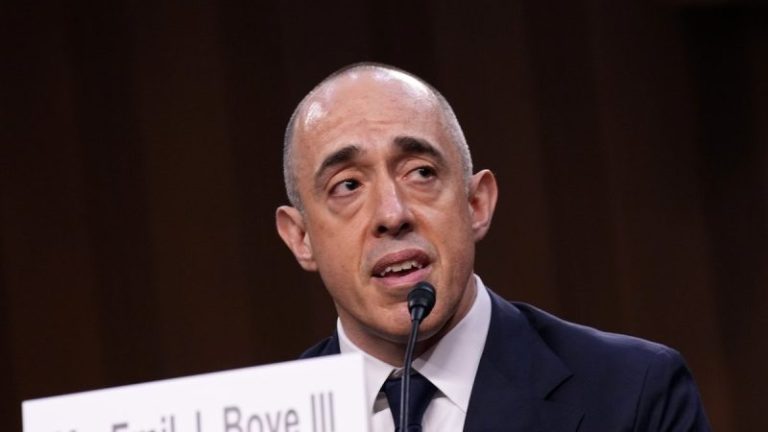
This week, Republican members of the Senate Judiciary Committee will once again be asked to draw the line between what is permissible and impermissible for a Trump nominee, when they decide whether Emil Bove’s nomination to the Third Circuit Court of Appeals should receive a full Senate vote.

Confirming Bove would mean redrawing that line to ignore serious concerns about his truthfulness under oath. I was in the room when he made statements that my colleagues and I understood as threats—meant to pressure us into signing a motion to dismiss the federal criminal case against New York City Mayor Eric Adams. Mr. Bove has since denied making any such statements in testimony before the Senate Judiciary Committee, but those denials do not reflect what actually took place.

In February of this year, then-Acting Deputy Attorney General Emil Bove ordered prosecutors in my former office, the Public Integrity Section, to dismiss the bribery case against Mayor Adams. Bove openly admitted in a memorandum that the dismissal was unrelated to the facts and the law. This led to the resignation of five Public Integrity Section prosecutors, including me, to go along with prosecutors from the U.S. Attorney’s Office in New York, who also refused the order and resigned. 

The Public Integrity Section has since been reduced to less than five prosecutors, meaning the only component of the Justice Department’s Criminal Division dedicated to prosecuting domestic public corruption exists almost entirely in name only today. 

In his written responses to members of the Senate Judiciary Committee, Bove flatly denied that he ever so much as suggested a threat to me and my colleagues, explaining that during the meeting with our section, ‘[i]t was never my intention to coerce, pressure, or induce an DOJ attorney – through adverse employment actions, threats, rewards, or otherwise – to sign the motion to dismiss the charges against Mayor Adams.’ But by the time of that meeting, it’s undisputed that he had already accepted the forced resignation of the U.S. Attorney in New York, put line prosecutors from that office on administrative leave for not signing the motion, and forced the entirety of the Public Integrity Section’s management to resign when it refused to carry out his order. And how does his denial square with his admission that he generally recalls ‘[telling us] he didn’t want to get anyone in trouble … so he didn’t want to know who was opposed to signing the motion’? 

Bove’s nomination would mark a troubling precedent: confirming a nominee who, in my view, gave testimony that was so obviously misleading to the committee and the American public. That’s what makes this so profoundly disturbing. Previous contested judicial confirmation hearings have involved accusations where one nomination’s credibility was pitted against that of an accuser, or judicial credentials were questioned. But never before has a nominee testified in such a demonstrably brazen manner with a wink and nod to the Republican committee members. 

There is only one realistic hope to prevent Bove’s nomination from moving forwardto a full floor vote, and it rests on the shoulders of Sen. Thom Tillis. The North Carolina Republican, a staunch conservative, has previously demonstrated political courage by speaking for his principles, not his party, on many issues. He believes in ‘calling the balls and strikes.’ 

Sen. Tillis prevented the confirmation of Edward Martin, the woefully unqualified nominee for U.S. Attorney in the District of Columbia, who used his office to pen threatening, typo-ridden letters to Democratic members of Congress, defense attorneys, and Georgetown University. Bove poses a far graver threat, in that his would be a lifetime tenure to a judicial branch he believes should not be a check on the president’s power.

Moreover, Trump’s latest tussle with Leonard Leo and the Federalist Society further reveals that he is no longer looking for jurists who are conservatives, but rather, loyalists. So, who would be better to elevate from a federal circuit court to the Supreme Court if Justices Thomas or Alito decided to retire before 2028 than Bove? 

On the Sunday night before I sent my resignation letter to Attorney General Bondi (Bove was cc-ed) on Monday, I was clearing out my belongings from my office when I noticed that someone had prominently placed a plaque on our reception desk. It quoted Abraham Lincoln: ‘If you want to test a man’s character, give him power.’ 

Bove served as line prosecutor earlier in his career – he knows the prosecutor’s code. But, in my experience, it appears that once he had a whiff of power, Bove was willing to abuse it. With his smug testimony, Bove has essentially called the Republicans’ bluff, believing that Sen. Tillis and the others won’t have the courage to vote against him.

Citizens of all political persuasions should hope that Sen. Tillis shows the courage and character that Bove lacks by voting no on his confirmation.

This post appeared first on FOX NEWS

In recent weeks, some public commentary has accused the Department of Justice of defying court orders and insinuated that Emil Bove’s confirmation will undermine the rule of law. Nothing could be further from the truth. The Department of Justice follows court orders—even when those orders are legally unsound or deeply flawed. And Emil is the most capable and principled lawyer I have ever known. His legal acumen is extraordinary, and his moral clarity is above reproach. The Senate should swiftly confirm him to the U.S. Court of Appeals for the Third Circuit.

This administration has repeatedly been targeted with sweeping, overreaching injunctions, often issued by ideologically aligned judges in defiance of settled law—including orders of the Supreme Court. Time and again, these rulings have been reversed on appeal, and easily so.  The pattern is familiar by now: aggressive district court orders grab headlines, only to be walked back when subjected to the slightest judicial scrutiny. 

Despite this consistent trend, the persistent narrative in the media and in the legal community is that it is the Department of Justice that ignores courts. That is plainly wrong. Disagreements over interpretation do not constitute defiance, any more than does filing an appeal. And, histrionics aside, good-faith disputes over timing and implementation of court orders do not represent insubordination—especially given the very difficult and novel problems presented by implementing the unprecedentedly overbroad and vague court orders imposed on this administration. The Department of Justice invariably complies with court orders no matter how much it disagrees with the underlying reasoning or the egregiousness of the judicial error. The appellate process has always been the means of securing relief from an erroneous order, and it still is.

You will search in vain for any critique of district judges who abuse their power and issue baseless injunctions in the editorial pages of The New York Times, CNN, or even the WSJ—even where those injunctions are reversed or stayed on appeal. 

The same commentators who foment anger over the Department of Justice’s good-faith efforts to comply with legally unsound court orders are silent when Article III judges overreach and issue rulings that interfere with the President’s authority and undermine the rule of law.

That brings me to my friend and colleague, Emil. The dedicated lawyers of the Department of Justice work tirelessly to comply with court orders and to promote the rule of law. There is no finer example of that dedication than Emil. 

In a thankless job, Emil expects excellence and courage from every lawyer in the Department, no matter the opposition faced. He pushes our dedicated lawyers to meet the moment and the mission of defending this administration against those who seek to block President Donald Trump from fulfilling his promises to the American people. And he consistently requires the highest level of integrity from all Department employees. 

Unfortunately, but unsurprisingly, the media has recently amplified slanderous attacks on Emil’s character based on a foundation of selective leaks, misleading reporting, and falsehoods. I am taking this opportunity to clear up a few of those misconceptions.

First, as to the termination of the leaker, it was Attorney General Pam Bondi and I who decided to terminate his employment. It was not Emil’s decision. And contrary to media spin, the employee was terminated for failing to defend his client—the United States of America—in open court; he was not dismissed for admitting an error in court. 

In his courtroom statements, the leaker distanced himself from the Department’s position and attempted to undermine the credibility of his own client. That is not zealous representation. That is an unethical dereliction of duty, which no client should be required to countenance.  

Moreover, Emil has never encouraged lawyers or anyone else to act in defiance of a court order. There was no order to violate at the time of the alleged statements. No injunctive relief had been granted—oral or written. No directive was issued to reverse any executive action. These facts are not in dispute, not even by the leaker. And most critically, after Judge Boasberg did issue an order in the relevant case, the Department fastidiously complied. That is not speculation. That is the explicit position taken by the leaker himself, who signed the government’s brief affirming the United States’ compliance on March 25, 2025. 

The same kind of distortions are being used to attack the Department’s lawful dismissal of the irreparably flawed case against New York Mayor Eric Adams. That decision was reviewed and approved by Department leadership and grounded in sound legal judgment. The judge agreed, granting the government’s motion to dismiss. 

That should end the conversation. But for those who insist on rehashing internal dissent and resignations, it should be obvious that disagreements within the Department do not render a decision unlawful or unethical. To the contrary, Emil’s integrity was displayed when he himself argued the case in favor of dismissal, even as his former colleagues in SDNY retreated. 

Before the Senate Judiciary Committee, Emil attested what those lucky enough to work with him already know to be true: he believes deeply in the rule of law, and in the importance of court orders. And what he has done time and again over the course of his career is bring rigor, integrity, and decency to his work. 

Emil has the backbone for hard cases, the restraint to wield judicial authority judiciously, and the intellect to master complexity. He will decide cases fairly. He will apply the law as written. He will not bend to political pressure. And that is exactly the kind of judge our country needs.

Emil is a dedicated public servant, an exemplary lawyer, and a person of quiet strength and deep character. 

The Senate should reject the smear campaign and vote to confirm him to the Third Circuit. Justice demands nothing less. 

This post appeared first on FOX NEWS

The State Department on Sunday blasted Yemen’s Iran-sponsored Houthi terrorist movement for lethal attacks on cargo ships in the Red Sea and on Israel as new calls emerged for President Donald Trump to support Yemen’s legitimate government to topple the Houthi regime.

Walid Phares, a leading American expert on the Middle East, told Fox News Digital that regarding ‘negotiations with Hamas and the regime in Tehran, in my view, Iran is simply buying time to rearm and resume its regional expansion.’ 

Phares said if the talks fail, there is a need ‘to reassemble a ground force comprised of units loyal to the legitimate Yemeni government (now in exile in Aden), and—crucially—the Southern Transitional Council (STC), whose forces are based in the Aden region and maintain frontlines adjacent to Houthi-controlled territory. Notably, STC forces have achieved the most significant victories against the Khomeinist militias in past years.’ 

Phares, who advised Trump when he was a candidate for president in 2016, continued, saying that ‘The United States should back, fund, and train these southern forces for renewed ground operations along the Red Sea coast, particularly to retake the vital port city of Hodeidah. Simultaneously, northern units loyal to the Yemeni government could advance toward the capital, Sanaa. Allied airpower would provide the necessary cover to enable a southern-northern pincer movement that could collapse the Houthi hold on Yemen and eliminate the threat entirely.’

He argued that ‘This would pave the way for future negotiations—not with Tehran’s proxies—but with a federated, pro-Western Yemeni government independent of Iranian influence. ‘

In May, Trump announced that after a military air campaign against the Houthi movement, saying the Houthis ‘just don’t want to fight…and we will honor that. We will stop the bombings.’

The Houthi terrorists, however, appear to have violated their pledge to Trump to stop attacks in the Red Sea.

Department of Defense spokesman Sean Parnell told Fox News Digital, ‘The DOD remains prepared to respond to any state or non-state actor seeking to broaden or escalate conflict in the region. Secretary Hegseth continues to make clear that, should Iran or its proxies threaten American personnel in the region, the United States will take decisive action to defend our people. We will not discuss future operations.’

Fox News Digital reported on July 7 that Israel exchanged missile fire with Iran-backed Houthi rebels in Yemen on Monday, targeting the group’s ports and other facilities.

Israel’s initial strikes came in reaction to a suspected Houthi attack on a Liberian-flagged ship in the Red Sea. The vessel was targeted with explosives and small arms fire, causing it to take on water and forcing the crew to abandon ship. The Houthis have not yet claimed responsibility for the attack. Israel’s military issued a warning prior to its attack, which targeted ports at Hodeida, Ras Isa and Salif.

‘These ports are used by the Houthi terrorist regime to transfer weapons from the Iranian regime, which are employed to carry out terrorist operations against the state of Israel and its allies,’ the Israeli military said.

The Houthi attacks last week resulted in the sinking of the bulk carrier Magic Seas, resulting in the presumed killings of four people and 11 others who are missing, according to an AP report.

The announcement came as satellite photos show long, trailing oil slicks from where the bulk carrier Eternity C went down, and another when the Houthis sank the bulk carrier Magic Seas.

The Times of Israel reported that both ships were attacked over a week ago by the rebels as part of their campaign targeting vessels over the war in Gaza. The Houthi campaign has upended shipping in the Red Sea, through which $1 trillion of goods usually passes a year.

A spokesperson for the State Department told Fox News Digital, ‘The United States condemns these attacks. These recent attacks have led to the loss of life, injury to sailors, and the sinking of cargo ships.Houthi attacks continue to endanger the lives of seafarers, harm economies across the region, and risk environmental disaster.’

The spokesperson added, ‘Global freedom of navigation and Israel have been under attack by the Houthi rebels for too long. The U.S. supports Israel’s ability to exercise its right to self-defense.’

After the Biden administration de-listed the Houthi movement as a foreign terrorist organization, the Trump administration swiftly restored the terrorist designation in March. 

The official slogan of the Houthi movement (Ansar Allah) reads, ‘Allah is Greater. Death to America. Death to Israel. Curse on the Jews. Victory to Islam.’ 

Fox News Digital’s Anders Hagstrom and AP contributed to this report.

This post appeared first on FOX NEWS

Though Senate Republicans were successful in their mission to pass President Donald Trump’s clawback package, not every member of the conference was on board.

Only two Republicans, Sens. Lisa Murkowski, R-Alaska, and Susan Collins, R-Maine, joined with every Senate Democrat to vote against the $9 billion package geared toward clawing back foreign aid and public broadcasting funding.

Senate Republican leaders had hoped that stripping $400 million in cuts to Bush-era international AIDS and HIV prevention funding could win over all the holdouts, both public and private. But the lawmakers who voted against the bill had deeper concerns about the level of transparency during the process and the impact successful rescissions could have on Congress’ power of the purse.  

Collins, who chairs the Senate Appropriations Committee, said she agreed with rescissions in general and supports them during the appropriations process, but couldn’t get behind the White House’s push because of a lack of clarity from the Office of Management and Budget (OMB) about exactly what would be cut and how.

She said that ‘the sparse text’ sent to lawmakers included little detail and did not give a specific accounting of programs that would be cut to hit the original $9.4 billion target.

‘For example, there are $2.5 billion in cuts to the Development Assistance account, which covers everything from basic education, to water and sanitation, to food security — but we don’t know how those programs will be affected,’ she said.

Murkowski demanded a return to legislating and appeared to warn that lawmakers were just taking marching orders from the White House rather than doing their own work. 

Both Murkowski and Collins were also concerned about the cuts to public broadcasting, particularly to rural radio stations. Both attempted to make changes to the bill during the vote-a-rama. Collins’ ultimately decided not to bring her amendment, which would have reduced the total amount of cuts in the bill to north of $6 billion, to the floor. However, Sen. Mark Kelly, D-Ariz., still brought the change for a vote. And Murkowski offered an amendment that would have drastically reduced the cuts to public broadcasting. 

The climactic vote for the bill came hours after tsunami warnings rippled through Alaska, and Murkowski argued that federal warnings were relayed through local public broadcasting. 

‘The tsunami warnings are now thankfully canceled, but the warning to the U.S. Senate remains in effect,’ she said. ‘Today of all days, we should vote down these misguided cuts to public broadcasting.’

Still, both attempts to modify the bill failed to pass muster. 

Their decision to go against the package left some scratching their heads. Sen. Ron Johnson, R-Wis., argued that the cuts amounted to less than a tenth of a percent of the federal government’s entire budget.

‘This should be a chip shot, OK? I have faith in [OMB Director] Russ Vought,’ he said. ‘I have faith in the Trump administration. They’re not going to cut things that are important spending.’

Sen. Eric Schmitt, R-Mo., who is leading the bill in the Senate, rebuked the duo’s arguments and said that lawmakers weighing in on the rescissions package was in line with their legislative duties.

‘That’s exactly what we’re doing,’ the Missouri Republican said. ‘I would hope that maybe what this will also do is highlight some of the wasteful spending, so when we get into the appropriations process in the next few months that we would be more keen to be focused on saving people money.’

Trump’s bill, which would cancel unspent congressionally approved funding, would slash just shy of $8 billion from the U.S. Agency for International Development (USAID), and over $1 billion from the Corporation for Public Broadcasting (CPB), the government-backed funding arm for NPR and PBS.

Some lawmakers, like Sen. Thom Tillis, who earlier this month voted against Trump’s ‘big, beautiful bill’ over cuts to Medicaid funding, understood where the pair were coming from.

The North Carolina Republican told Fox News Digital that Collins, in particular, would be leading negotiations for an end-of-year bipartisan funding deal with Senate Democrats, and to vote in favor of canceling congressionally approved funding could hurt her ability to find a solution to keep the government funded.

‘I don’t think people really understand the value of your word and your consistency and your living up to commitments and how important that is to getting things done,’ Tillis said. ‘And this, I think, that’s what Susan’s looking at, I think Murkowski is as well, and I respect them for that.’

This post appeared first on FOX NEWS

A new think tank analysis finds that public corruption is a significant problem in the U.S., and is most prevalent in state and local governments that have larger bureaucracies and higher regulations.

The libertarian Cato Institute said it analyzed Department of Justice data on public corruption convictions in the nation’s 94 federal judicial districts and measured the annual average number of convictions per 100,000 population over the 2004–2023 period.

‘The data show that some of the most corrupt places by this measure match their reputations,’ the authors of the Cato analysis wrote.

Washington, D.C., topped the rankings with 469 total convictions during the nearly 20-year period and an annual conviction rate of 3.49, according to Cato’s report.

‘It has a huge number of legislative and executive branch federal employees, and there are many opportunities for graft,’ the report says.

Louisiana’s eastern district, which includes New Orleans, ranks at number four on Cato’s list with 430 total convictions during this period and an annual conviction rate of 1.29.

‘New Orleans has long been infamous for state and local corruption,’ the report says.

The Cato analysis found that New Hampshire had the lowest public corruption by this metric, with 13 convictions over the period and an annual conviction rate of .05. Cato called it ‘the freest state in the nation with one of the smallest governments.’

Cato said it appeared that ‘larger governments with more spending and regulations create more opportunities for bribery and embezzlement.’ 

The think tank, however, noted that some academic studies have suggested other reasons for corruption differences between states and cities, including varying cultures, education levels, and poverty rates.

This post appeared first on FOX NEWS

Consumer prices rose in June as President Donald Trump’s tariffs began to slowly work their way through the U.S. economy.

The consumer price index, a broad-based measure of goods and services costs, increased 0.3% on the month, putting the 12-month inflation rate at 2.7%, the Bureau of Labor Statistics reported Tuesday. The numbers were right in line with the Dow Jones consensus, though the annual rate is the highest since February.

Excluding volatile food and energy prices, core inflation picked up 0.2% on the month, with the annual rate moving to 2.9%, with the annual rate in line with estimates. The monthly level was slightly below the outlook for a 0.3% gain.

A worker prices produce at a grocery store in San Francisco, California, US, on Friday, June 7, 2024.David Paul Morris / Bloomberg via Getty Images

Prior to June, inflation had been on a generally downward slope for the year, with headline CPI at a 3% annual rate back in January and progressing gradually slower in the subsequent months despite fears that Trump’s trade war would drive prices higher.

While the evidence in June was mixed on how much influence tariffs had over prices, there were signs that the duties are having an impact.

Vehicle prices fell on the month, with prices on new vehicles down 0.3% and used car and trucks tumbling 0.7%. However, tariff-sensitive apparel prices increased 0.4%. Household furnishings, which also are influenced by tariffs, increased 1% for the month.

Shelter prices increased just 0.2% for the month, but the BLS said the category was still the largest contributor to the overall CPI gain. The index rose 3.8% from a year ago. Within the category, a measurement of what homeowners feel they could receive if they rented their properties increased 0.3%. However, lodging away from home slipped 2.9%.

Elsewhere, food prices increased 0.3% for the month, putting the annual gain at 3%, while energy prices reversed a loss in May and rose 0.9%, though they are still down marginally from a year ago. Medical care services were up 0.6% while transportation services edged higher by 0.2%.

With the rise in prices, inflation-adjusted hourly earnings fell 0.1% in June, the BLS said in a separate release. Real earnings increased 1% on an annual basis.

Markets largely took the inflation report in stride. Stock market indexes were mixed while Treasury yields were mostly negative.

Amid the previously muted inflation ratings, Trump has been urging the Federal Reserve to lower interest rates, which it has not done since December. The president has insisted that tariffs are not aggravating inflation, and has contended that the Fed’s refusal to ease is raising the costs the U.S. has to pay on its burgeoning debt and deficit problem.

Central bankers, led by Chair Jerome Powell, have refused to budge. They insist that the U.S. economy is in a strong enough position now that the Fed can afford to wait to see the impact tariffs will have on inflation. Trump in turn has called on Powell to resign and is certain to name someone else to the job when the chair’s term expires in May 2026.

Markets expect the Fed to stay on hold when it meets at the end of July and then cut by a quarter percentage point in September.

This post appeared first on NBC NEWS

Investor Insight

With a clear vision for value creation in the energy transition and precious metals sectors, Surface Metals has strategically assembled one of North America’s most compelling project portfolios. Anchored by a high-potential gold asset and a robust lithium pipeline, the company is focused on discovery-driven growth, resource development, and unlocking long-term shareholder value through exploration, partnerships and potential M&A.

Overview

Surface Metals (CSE:SUR,OTCQB:SURMF) is a diversified exploration and development company with a portfolio spanning precious metals and lithium, targeting the growing global need for electrification metals and gold as a financial hedge.

The company’s flagship Cimarron gold project in Nevada is an underexplored, high-grade oxide gold system with historic drilling by majors including Newmont and Echo Bay. Simultaneously, Surface Metals, through its subsidiary ACME Lithium US, is developing lithium projects across Nevada and Manitoba, Canada. These include the Clayton Valley lithium brine asset (with a defined resource), the claystone-hosted Fish Lake Valley project, and the pegmatite-rich Shatford and Cat-Euclid claims in partnership with Snow Lake Resources.

Surface Metals’ projects are located in prolific mining jurisdictions in Nevada and Manitoba

With a foundational 43-101 resource, compelling exploration upside, and strategic positioning next to producing and near-producing lithium assets, Surface Metals is building value from the ground up.

Company Highlights

  • Dual Focus Portfolio: Combines precious metals and energy transition minerals, including a 90 percent stake in the Cimarron gold project and multiple lithium assets in Nevada and Manitoba.
  • Gold Asset with Legacy Database: Cimarron contains over 190 historical drill holes with high-grade intercepts and a non-compliant historic resource of 50,000+ oz gold, open in multiple directions.
  • NI 43-101 Lithium Resource: The Clayton Valley project hosts an inferred lithium carbonate equivalent (LCE) resource of 302,900 tonnes, backed by geophysics, drilling and pumping test data.
  • Strategic Lithium Locations: Lithium claims are adjacent to Albemarle’s Silver Peak mine and Ioneer’s Rhyolite Ridge development in Nevada, and contiguous to the Tanco mine in Manitoba.
  • Experienced Leadership: Led by resource sector veterans with a track record of successful exits, technical development and public company management.
  • Energy Transition Strategy: Well-positioned to benefit from macro tailwinds in lithium demand and US domestic critical minerals supply chain policies.

Key Projects

Cimarron Gold Project

The Cimarron gold project is a high-grade epithermal gold exploration project located at the north end of the San Antonio Mountains in the historic San Antonio (Cimarron) mining district, approximately 18 miles north of Tonopah, Nevada. Surface Metals holds a 90 percent interest in the project through its US subsidiary, Surface Metals US Inc. The project comprises 31 lode claims and is characterized by shallow, structurally controlled, low-sulfidation oxide gold mineralization.

Cimarron lies at the intersection of two regionally significant gold trends: the northwest-trending Walker Lane Belt and a north-northeast trend hosting Round Mountain (Kinross), Bullfrog, Goldfield, Manhattan and Gold Hill deposits. Notably, Round Mountain—located just 28 miles north—has produced more than 15 million ounces of gold. The project benefits from excellent infrastructure, including nearby power, road access and historic drill pads.

Aerial view of the project property

From 1980 to 2004, significant historical exploration was conducted by major operators such as Newmont, Echo Bay, Romarco and Budge. More than 190 drill holes define three main mineralized zones: West, Central and East. Echo Bay’s internal reports (1987) estimated a non-NI 43-101 compliant resource of over 50,000 oz of gold hosted in approximately 1.5 million tons (Mt), with roughly 80 percent of the ounces located in the West Zone. Historic high-grade intercepts include:

  • 4.46 grams per ton (g/t) gold over 11 m
  • 4.49 g/t gold over 23 m
  • 3.94 g/t gold over 46 m

Mineralization remains open in multiple directions, and surface sampling has returned anomalous gold values across a wide area, indicating strong potential for both lateral and vertical extensions. The mineralized system features strong structural controls and is interpreted to be part of a shallow, boiling zone epithermal system.

Surface Metals is currently finalizing its 2025/2026 exploration interpretation and strategy to potentially expand the known mineralized envelope and produce an NI 43-101 compliant resource estimate.

Clayton Valley Lithium Brine Project

The Clayton Valley Project, held through Surface’s subsidiary ACME Lithium US, is located in Esmeralda County, home to the only operating lithium brine mine in the United States: Albemarle’s Silver Peak mine. ACME’s 100 percent interest covers 122 placer claims totaling 2,440 acres in one of the world’s most prolific lithium-producing basins.

The project hosts a defined NI 43-101 inferred resource of 302,900 tons of lithium carbonate equivalent (LCE), based on extensive geophysical surveys (gravity and HSAMT), Phase 1 and Phase 2 drilling, and a 10-day pump test. The brines are hosted in interbedded silts, clays, sand and gravel, with lithium concentrations in brine ranging from 38 to 130 mg/L. Borehole DH-1 confirmed brine presence from 85 meters to 370 meters, with increased concentrations in basal gravels and lacustrine tuff layers.

Phase 2 drilling (DH-1A and TW-1) reached a depth of 1,940 ft, intersecting the Lower Gravel Unit (LGU), interpreted as the main brine aquifer. Pack testing and zone-isolated sampling from the LGU showed lithium values up to 71 mg/L. Permeability tests demonstrated favorable aquifer transmissivity. The presence of bicarbonate-rich groundwater indicates typical Clayton Valley geochemistry, conducive to direct lithium extraction (DLE) processing. Surface is currently evaluating DLE partnerships and pilot testing, with SLB (formerly Schlumberger) having already demonstrated a working DLE unit in the region.

Fish Lake Valley Lithium Claystone Project

The Fish Lake Valley (FLV) project is a 100 percent owned sedimentary lithium claystone asset covering 207 claims across 4,002 acres in Esmeralda County. The project is strategically adjacent to Ioneer’s fully permitted and DOE-funded Rhyolite Ridge lithium-boron project, with expected commencement of construction in 2025 and offtake agreements with Ford, Panasonic and Toyota.

FLV hosts lithium values up to 1,418 parts per million (ppm) in surface samples, with boron anomalies as high as 1,964 ppm—both strong indicators of favorable sedimentary lithium potential. Two major field sampling programs (2022 and 2023) confirmed the widespread presence of lithium-bearing illite-smectite clays. Phase 2 sampling utilized Asterra’s satellite analytics to identify new mineralized zones.

Geophysical surveys, including gravity and HSAMT, confirm the presence of a deep down-dropped basin with clay-rich horizons extending to over 1.3 km depth. Interpreted illite-smectite units, comparable to Rhyolite Ridge’s host rocks, are present throughout the basin. The project is fully permitted for drilling, with multiple high-priority drill targets identified for validation and resource definition. Surface is actively seeking a JV or strategic partner to fund and advance this asset.

Shatford, Birse and Cat-Euclid Lake Lithium Projects

Surface Metals, in partnership with Snow Lake Resources (Nasdaq:LITM), holds a 49 percent interest in a 17,000-acre pegmatite exploration portfolio in southeastern Manitoba, contiguous with the Tanco mine, Canada’s only operating LCT (lithium-cesium-tantalum) pegmatite mine, owned by Sinomine.

The Shatford Lake project comprises 21 claims (8,883 acres), Birse Lake adds another 10 claims (5,196 acres), and the Cat-Euclid block includes six claims (2,930 acres). The claims straddle the Greer-Shatford Shear Zone, a major 15-km structural corridor hosting known pegmatites, favorable host rocks and historic lithium occurrences.

Snow Lake’s 2024 field campaign discovered a 25 m to 30 m wide tantalite-bearing pegmatite on the Cat-Euclid block and identified multiple new pegmatite swarms under heavy overburden. Drilling at Shatford Lake (2023) included eight holes totaling 3,280 meters, intersecting pegmatites in six holes. 3D modeling of airborne magnetic data correlated structural dilation zones with pegmatite emplacement, prime targets for lithium mineralization. Multiple new drill targets have been identified for follow-up in 2025. The joint venture provides a low-cost pathway to potential lithium discoveries near a fully integrated lithium processing facility.

Management Team

Stephen Hanson – President, CEO and Director

With over 28 years of global experience in finance and corporate development, Stephen Hanson has held executive roles across mining, energy and resource sectors. He has successfully executed M&A deals and created exit strategies for multiple public and private companies. Hanson’s focus at Surface Metals is on unlocking value through resource expansion and strategic partnerships.

Zara Kanji – CFO and Corporate Secretary

A CPA with deep experience in financial reporting for junior mining companies, Zara Kanji oversees compliance, budgeting, and financial strategy. She brings more than two decades of expertise in audit, taxation and advisory for public entities in Canada.

Vivian Katsuris – Director

A capital markets specialist with over 28 years of experience, Vivian Katsuris has served in executive and board roles for numerous TSXV and CSE-listed companies. Her expertise spans brokerage, corporate governance and strategic advisory.

Yannis Tsitos – Director

Formerly with BHP Billiton for 19 years, Yannis Tsitos has decades of exploration and M&A experience across multiple continents. He is currently the president of Goldsource Mines and sits on several public company boards.

William Feyerabend – Qualified Person (US Projects)

A certified professional geologist and NI 43-101 Qualified Person, William Feyerabend has authored multiple technical reports on lithium assets and has decades of exploration experience in the US, Mexico and South America.

Dane Bridge – Technical Advisor

With over 45 years in global mineral exploration and mine evaluation, Dane Bridge provides strategic technical oversight across Surface’s exploration assets.

Matt Banta – Technical Advisor

A specialist in hydrology and lithium brine systems, Matt Banta brings over 20 years of field and analytical experience with a focus on lithium extraction and water resource modeling.

This post appeared first on investingnews.com