
Author

admin

Browsing

While the 2024 assassination attempt against President Donald Trump in Butler, Pennsylvania, has resulted in a host of changes to bolster the Secret Service’s security practices, the agency has its work cut out for it in an era of unprecedented threats against the president, according to former Secret Service agents. 

Trump faces a plethora of threats, ranging from violent extremists backed by proxy groups, to domestic actors inspired to incite violence amid heightened political rhetoric, according to experts.

‘No U.S. president has been under so much threat of violence,’ Bill Gage, who served as a Secret Service special agent during Presidents George W. Bush and Barack Obama’s administrations, told Fox News Digital Wednesday. ‘The threat on President Trump is the greatest that any president has ever faced.’

Twenty-year-old gunman Thomas Matthew Crooks opened fire on Trump from a rooftop during the rally — with one of the eight bullets shot grazing Trump’s ear. In addition to injuring two people, the gunman also shot and killed Corey Comperatore, a 50-year-old firefighter, father and husband attending the rally. 

Months later, another man was apprehended and charged with attempting to assassinate Trump at his Trump International Golf Club in West Palm Beach, Florida. Both incidents are under investigation. 

Political rhetoric from the left that paints Trump as a threat to democracy is dangerous and could provide fodder for political radicals to believe assassinating the president is the way to save the country — potentially leading to a similar assassination attempt seen in Pennsylvania, Gage said.

Other factors contributing to the heightened threat levels include policies related to immigration or funding cuts from the newly created Department of Government Efficiency (DOGE) that are unpopular with the left, as well as hostile proxy groups who are backed by actors like Iran who oppose Trump, Gage said. 

‘That increases the threat level on Trump,’ Gage said. ‘There’s probably dozens and dozens of threats every day, just sort of insider threats, or threats within our own borders that the Secret Service has to run down.’ 

Specifically, Gage pointed to comments from leaders like Democratic California Gov. Gavin Newsom, who delivered an address to the nation in June where he claimed ‘democracy is under assault,’ following the Trump administration’s decision to dispatch thousands of National Guard troops and hundreds of Marines to respond to the immigration riots in the Golden State and place them under federal command, rather than state command. 

‘Right now there is someone out there reading Newsom’s quotes, someone who wishes President Trump harm,’ Gage said in an email in June to Fox News Digital. ‘It is up to the USSS to stop them. Hopefully those wishing the President harm will not slip through the cracks.’

A spokesperson for Newsom did not immediately respond to a request for comment from Fox News Digital. 

Trump isn’t the only subject that’s a potential target for politically motivated violence. 

Attacks against federal immigration officials are on the rise and a gunman opened fire against Border Patrol agents Monday at an annex in McAllen, Texas. Authorities have yet to identify a motive. 

However, lawmakers have not minced their words on Trump’s immigration agenda. In June, Rep. Pramila Jayapal, D-Wash., accused ICE of acting ‘like a terrorist force’ — comments she has since defended. 

Rep. Michael Guest, R-Miss., who oversees the House Homeland Security committee’s subcommittee on border security and enforcement, said in a Wednesday statement to Fox News Digital that ‘radical anti-law enforcement rhetoric’ has prompted the surge in violence against federal immigration officials.  

Meanwhile, threats continue to change, creating additional challenges for security forces like the Secret Service as they adapt. 

Although the Secret Service is taking action to enhance its security measures, the agency still faces ‘considerable vulnerabilities given the rising complexity and sophistication of the threats it faces,’ Tim Miller, who served as a Secret Service agent during Presidents George H.W. Bush and Bill Clinton’s administrations, said in an email Wednesday to Fox News Digital.

‘The FBI has consistently warned about homegrown violent extremists, which remains a major concern,’ Miller said. 

While Miller characterized Butler as a ‘wake-up’ call for the Secret Service and said the incident is sharpening the agency’s ability to handle threats, there is still a lot of work that must be done, he said. 

‘The Secret Service is also still playing catch-up when it comes to adopting critical technology — especially in the areas of secure communications, drone surveillance, and real-time intelligence tools,’ Miller said. ‘These are not luxuries; they are vital to modern protective operations.’

A bipartisan House task force that investigated the attack found that the attempted assassination was ‘preventable,’ and determined various mistakes were not an isolated incident. 

At the top of the list of mistakes, the report identified that the Secret Service did not secure a ‘high-risk area’ next to the rally, the American Glass Research (AGR) grounds and building complex. Failure to secure this area ‘eventually allowed Crooks to evade law enforcement, climb on and traverse the roof of the AGR complex, and open fire.’ 

Other faults the task force found included handing over advance planning roles to inexperienced Secret Service personnel, along with various technology and communication breakdowns. 

‘Moreover, relevant threat information known by members of the intelligence community was not escalated to key personnel working the rally,’ the House task force said in its report. 

As a result, the agency has spearheaded a series of reforms. 

According to former Secret Service acting director Ronald Rowe, immediate changes to the agency following Butler, Pennsylvania, included expanding the use of drones for surveillance purposes, and also incorporating greater counter-drone technology to mitigate kinetic attacks from other drones. 

The agency also overhauled its radio communications networks and interoperability of those networks with Secret Service personnel, and state and local law enforcement officers, Rowe told lawmakers on a bipartisan House task force investigating the assassination attempt in December 2024.  Updates to these radio communications are a significant change, according to Gage, who noted that he could carry up to five radios at a time because an integrated system didn’t exist.

Rowe also told lawmakers that the Secret Service was aiming to up its staffing in the next year, and had placed more special agents in Trump’s security detail. Some of the additional $231 million in funding that Congress approved for the Secret Service in a stopgap spending bill in September 2024 to hire 1,000 new agents and officers in 2025 would go toward these increased hiring plans, Rowe said. 

A few other changes are in the pipeline, including possibly building a precise replica of the White House. Historically, agents have trained using Tyler Perry’s White House replica at his Atlanta film studio. 

Secret Service director Sean Curran said in an interview on Fox News’ ‘My View with Lara Trump’ in April that the agency is working with the White House to install such a building at the James J. Rowley Training Center, a 500-acre center in Laurel, Maryland. 

‘In order for our officers and agents to train up properly, they have to see what it’s like to be at the White House,’ Curran said. ‘It’s an important complex to know. There’s a lot of ins and outs, and something as simple as the local fire department showing up to help with a fire, and they need to know where they are going.’ 

Altogether, Congressional oversight bodies issued nearly 50 recommendations to the Secret Service following the assassination attempt, including ones related to better radio communications and planning for events. The agency reported Thursday that it has executed 21 of those recommendations, and is in the process of implementing 16 others. 

‘The reforms made over this last year are just the beginning, and the agency will continue to assess its operations, review recommendations and make additional changes as needed,’ the Secret Service said in a news release Thursday.
This post appeared first on FOX NEWS

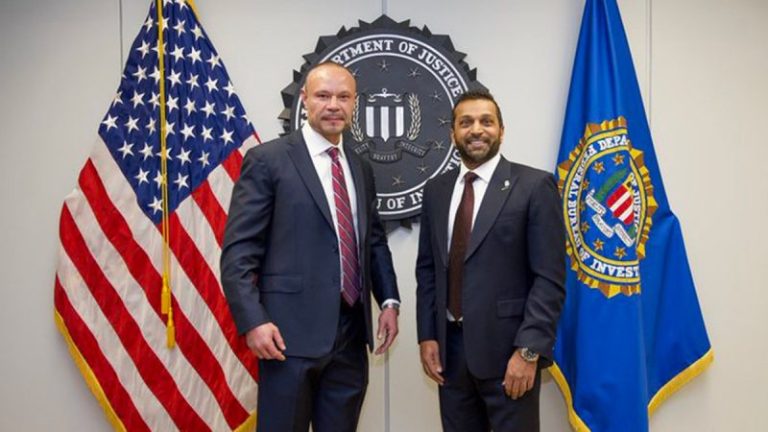
FBI Deputy Director Dan Bongino was outraged this week during a closed-door White House meeting about the Department of Justice’s review of Jeffrey Epstein’s sex trafficking case files, according to multiple sources.

Bongino raised his voice during a discussion with White House chief of staff Susie Wiles before storming out of the meeting, according to two sources close to DOJ leadership. Bongino also exchanged heated words with Attorney General Pam Bondi during the meeting, and the whole ordeal has led him to consider resigning from the FBI, another source said.

Another person with knowledge of the meeting disputed the characterization that Bongino yelled at Wiles or Bondi during the sitdown.

However, that person agreed that Bongino was ‘enraged.’ The source said the deputy director was angry about the Epstein memo rollout and what he viewed as Bondi’s ‘lack of transparency from the start.’ The memo, a joint product of the DOJ and FBI, said the two agencies had no further information to share with the public about Epstein’s case, a revelation that sparked fury among the MAGA base. The memo first appeared in Axios over the weekend, and then the DOJ and FBI published it Monday.

Asked about the claim that Bongino yelled at Wiles, a White House official said it was ‘100% false.’ Wiles is a veteran of Florida politics who led Trump’s campaign, and the president has described her as ‘universally admired.’

The fracture in DOJ and FBI leadership spilled into the public on Friday amid fallout from the memo.

The memo stated that the DOJ and FBI concluded their review of Epstein’s files and did not find any information that could lead to charges against anyone new.

Despite Bongino reportedly now breaking with leadership over the memo and weighing resignation, people familiar with the matter said as of Friday that FBI Director Kash Patel and Bondi remained in communication and that Patel is happy with his job.

A DOJ spokesman and an FBI spokesman did not respond to requests for comment.

Bongino, a former Secret Service agent with no prior FBI experience, hosted a popular podcast before Trump tapped him to serve in the No. 2 role at the bureau. On his show, Bongino repeatedly raised alarm over Epstein’s ‘client list,’ saying ‘there’s a reason they’re hiding it’ and that its release would ‘rock the political world.’

But in the memo released on Monday, the FBI and DOJ said they uncovered no such list.

Bongino, Bondi and Patel are all facing blowback over the Epstein files from a faction of their supporters, who say they reneged on repeated vows to open the curtain on details of Epstein’s case.

Epstein, a financier who was known to engage with wealthy, well-known figures, was indicted in 2019 over allegations he recruited dozens of women, including minors as young as 14, and had sexual relations with them or sexually abused them. His associate Ghislaine Maxwell was convicted of conspiring to sexually abuse minors and is serving a 20-year prison sentence. She has an appeal pending.

The DOJ and FBI said in their memo that much of the nonpublic information related to Epstein’s case is under court-ordered seals or contains child pornography and private information about victims.

Before joining the bureau, Patel and Bongino both advanced theories that the government was hiding information about the case, including a supposed ‘list’ of unindicted sexual predators.

The DOJ and FBI’s memo poured cold water on that idea by noting that the agencies found ‘no incriminating ‘client list.”

Deputy Attorney General Todd Blanche said in a statement on X that DOJ and FBI leadership, including Bongino, were in lockstep during the compilation and release of the memo. The idea that ‘there was any daylight’ between the FBI and DOJ was ‘patently false,’ Blanche said.

Bongino was not at work on Friday because he was so upset by the fallout from the Epstein memo, sources said. One said Bongino had not anticipated the backlash from his supporters.

Fox News’ David Spunt and Jake Gibson contributed to this report.

This post appeared first on FOX NEWS

Is the market flashing early signs of a shift?

In this week’s video, Mary Ellen McGonagle breaks down the subtle but telling moves happening under the surface. From strength in semiconductors, home builders, and energy to surging momentum in Bitcoin and silver, Mary Ellen highlights the sectors gaining traction and the technical setups traders should have on their radar.

She also spots stocks breaking above key moving averages, potential reversal patterns, and discusses actionable insights heading into earnings season.

If you’re looking for timely trade ideas and a roadmap to where money is flowing next, don’t miss this breakdown.

This video premiered on July 11, 2025.

You can watch it on our dedicated page for Mary Ellen’s videos.

New videos from Mary Ellen premiere weekly on Fridays. You can view all previously recorded episodes at this link.

If you’re looking for stocks to invest in, be sure to check out the MEM Edge Report! This report gives you detailed information on the top sectors, industries and stocks so you can make informed investment decisions.

As we navigate the evolving stock market landscape, understanding key sectors and their trends is important, especially during earnings season. This week, the spotlight shines on the Financial sector, with several of the largest banks reporting. Five of the top 10 holdings within the Financial Select Sector SPDR ETF (XLF) are on deck: J.P. Morgan (JPM), Goldman Sachs (GS), Bank of America (BAC), Wells Fargo (WFC), and Morgan Stanley (MS). 

This week we will focus on the Financial sector via XLF and zoom in on one of its top components, Goldman Sachs.

The Financial Sector: A Technical Look at XLF

XLF has been outperforming the S&P 500 ($SPX), experiencing new all-time highs, and has been a leading sector in the most recent market rebound.

Now that all banks that were susceptible to the Fed’s stress test have passed with flying colors, questions loom about whether less stringent regulations will lead to more growth. The sector has not experienced much M&A activity, and the IPO market has yet to come back to a healthy level of activity. However, there is hope that a banking renaissance is on the horizon, and maybe this quarter will give a rosier outlook than more recent forecasts.

Technically, XLF looks promising. Shares broke out to new all-time highs ahead of earnings and are now set up with good risk/reward potential for investors. 

The pattern from which it broke out is a bit of a wonky head-and-shoulders pattern. I’d call this a stretch as it isn’t picture perfect, but the price image presented is close enough to set parameters to trade. 

The breakout on a gap to new highs is extremely bullish, and that gap level could be used as a stop-loss to the downside, worst case should be the rising 50-day moving average. Buyers should come back into the sector there on a dip.

Goldman Sachs (GS): A Bellwether

Goldman Sachs, the largest component in the price-weighted Dow Jones Industrial Average, reports results on Wednesday morning just days after hitting all-time highs. Investors will be looking for any commentary focused on tariffs and margins. 

Has there been any impact on their results, or have concerns about inflation been overblown? Any earnings pressure on their bottom line could cause ripple effects throughout other sectors like industrials, materials, and technology. 

Shares declined 33% then rallied 65% from their April 7 lows. Shares may need a breather as they are overbought, but that’s where opportunity may lie. Wouldn’t chase it just yet. I would own for the long term, but price action could be very interesting when they report next week. 

One bold prediction — look for a possible stock split announcement. Since their debut in 1999, shares have never split. Seeing the recent price surge and its size in the Dow, that option should be on the table. 

Technically, shares have been on a tremendous run as they’ve rallied 65% from their April 7 lows. Shares may need a breather as they are overbought, but that may be where the opportunity lies when they report next week. 

The stock has rallied with a series of gaps along the way. Those gaps tell a story, and it’s worth watching the most recent gap from $690 to $700. Each jump higher has not experienced a full retracement — a gap fill, if you will.

The gaps higher have been very bullish. The first large gap — a breakaway gap — started the main part of this rally. We have seen a series of smaller gaps that helped extend the rally. Now, we may be tiring. Watch the $690 level to see if that gap can hold. If it can’t, then there may be more selling pressure over the near term. 

A healthy pullback given the strong bull run is likely, but buyable. A break below $690 could see a swift move lower to the $665 level. If things turn negative, then the rising 50-day moving average, which coincides with a key Fibonacci retracement level just below $620 would be an ideal entry point from a risk/reward perspective. 

The good news is that any weakness in the stock looks like it should be met with great opportunities to enter the name. The long-term trend is up, and the momentum is there not only in the stock but within the sector. The long-term trader shouldn’t fret earnings; the swing trader may get an opportunity to buy a dip from an overbought condition. The bad news would be that the stock gaps higher again and continues its upward trajectory. 

Beyond Financials: Johnson & Johnson (JNJ)

While financials take center stage, we want to touch upon another significant company reporting this week: Johnson & Johnson (JNJ).

JNJ shares have remained relatively flat for the better part of five years. Much of the earnings focus will be on plans to navigate patent expirations. 

Merck acquired Verona last week. The patent cliff will continue to be a hot topic for the entire pharma industry. As for JNJ, it’s confronting the expiration of exclusivity on Stelara, its $10B+ immunology blockbuster drug. The exclusivity expires first in Europe this year and then in the U.S. in 2026.

As for reaction to earnings, don’t expect too much activity. The average move post-results has been +/- 2.05%. Shares have traded lower after five of the last seven times. Shares of the Dow stock are up 8% year-to-date and -9% off their highs.

Technically, there isn’t much to see here. We backed it out to look at price in a five-year weekly range to illustrate that point.

Shares have been in a wide range between roughly $138 to $168 over this lengthy span. Yes, I yawned when I typed this out — it’s that boring. We don’t expect much to change, but there are small setups for a shorter-term swing trader.

The stock, while breaking above the midpoint of this longer-term range, is forming a bullish ascending triangle and has, albeit tight, risk/reward parameters for those looking to trade. 

To the downside, look for the continued near-term uptrend to hold and find support right at the 200-day moving average just below $153. A good entry point in which one could manage risk. 

To the upside, a break above $158 could take shares to their recent highs and slowly and steadily towards the $168 level. The set-up is far from ideal when looking at the longer-term action, but near term, there could be a quick play and maybe, just maybe, shares can finally escape the longer-term neutral range. 


The S&P continues to push higher, with the equity benchmark almost reaching 6300 this week for the first time in history. With so many potential macro headwinds still surrounding us, how can the market continue to reflect so much optimism? On the other hand, when will bulls wake up and realize that this market is obviously overextended and rotate significantly lower?

With the S&P 500 once again achieving new all-time highs, and with Q2 earnings just around the corner, I thought it would be a perfect time to revisit an exercise in probabilistic analysis. Basically, I’ll lay out four different scenarios for the S&P 500 index between now and late August. Which path do you see as the most likely and why? Watch the video, check out the first scenarios, and then cast your vote!

By the way, we last ran this analytical process on the S&P 500 back in May, and check out which scenario actually played out!

And remember, the point of this exercise is threefold:

  1. Consider all four potential future paths for the index, think about what would cause each scenario to unfold in terms of the macro drivers, and review what signals/patterns/indicators would confirm the scenario.
  2. Decide which scenario you feel is most likely, and why you think that’s the case. Don’t forget to drop me a comment and let me know your vote!
  3. Think about how each of the four scenarios would impact your current portfolio. How would you manage risk in each case? How and when would you take action to adapt to this new reality?

Let’s start with the most optimistic scenario, with the S&P 500 index continuing the recent uptrend phase to retest all-time highs by June.

Option 1: The Super Bullish Scenario

The most bullish scenario would involve the S&P 500 continuing a similar trajectory that we’ve seen off the April low. Growth continues to dominate, tariffs remain essentially a non-issue, volatility remains lower, and the market moves onward and ever upward!

Dave’s Vote: 10%

Option 2: The Mildly Bullish Scenario

What if the uptrend continues, but at a much slower rate? The “mildly bullish scenario” would mean the S&P 500 probably tops out around 6300-6400 but doesn’t get any further. Perhaps a leadership rotation emerges, and technology stocks start to pull back as investors rotate to other sectors and themes. Lack of upside momentum from the largest growth names slows the uptrend in a big way.

Dave’s vote: 30%

Option 3: The Mildly Bearish Scenario

Maybe “the top” is already in, and even though July is traditionally a strong month, we see a corrective move into August that brings the S&P 500 down to the 200-day moving average. Bulls and bears would probably feel quite vindicated here, as bulls would see this as a healthy pullback, and bears would see this as a serious wake up call for investors.

Dave’s vote: 45%

Option 4: The Very Bearish Scenario

We always need a doomsday scenario, and here we’ll describe how the S&P 500 could go back down to retest the May price gap. If Q2 earnings season becomes all about companies reflecting on a significantly negative impact from potential tariffs, and investors begin to not just complain about overvalued stocks but actually start selling as a result, we could certainly see a downside move to retrace about 38.2% of the April to July uptrend phase.

Dave’s vote: 15%

What probabilities would you assign to each of these four scenarios? Check out the video below, and then drop a comment on which scenario you select and why!

RR#6,

Dave

PS- Ready to upgrade your investment process?  Check out my free behavioral investing course!

David Keller, CMT

Chief Market Strategist

StockCharts.com

Disclaimer: This blog is for educational purposes only and should not be construed as financial advice.  The ideas and strategies should never be used without first assessing your own personal and financial situation, or without consulting a financial professional.  

The author does not have a position in mentioned securities at the time of publication.    Any opinions expressed herein are solely those of the author and do not in any way represent the views or opinions of any other person or entity.

If you’re serious about trading or investing, establishing a weekly market routine is a must. But where do you begin?  

In this eye-opening video, Grayson Roze, Chief Strategist at StockCharts, shares the method he uses every week to stay aligned with the market’s biggest drivers — the top 25 stocks by market cap

Learn how to build a customized ChartList of these stocks, sort the stocks by market cap, and different ways to review them to spot long-term trends or reversals.

Whether you’re new to charting or a seasoned technician, this routine could transform how you view the market. 

This video originally premiered on July 11, 2025. Click on the above image to watch on our dedicated Grayson Roze page on StockCharts TV.

You can view previously recorded videos from Grayson at this link.

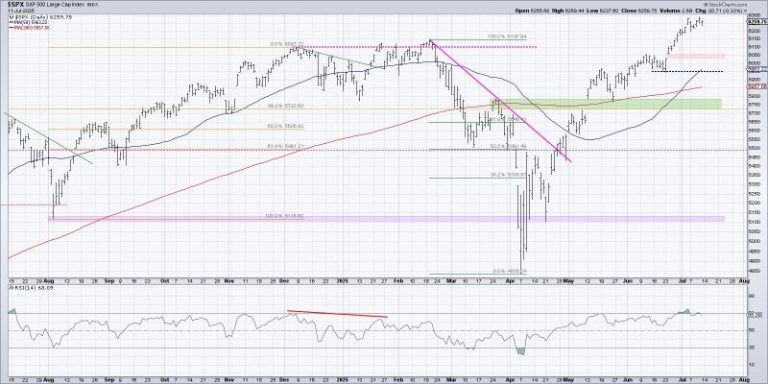
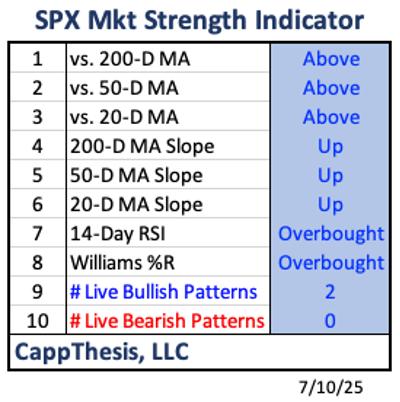
Up to this point, the S&P 500 ($SPX) has now stayed above the 6,200-mark for eight straight days. The upside follow-through has been limited, but the drawdown has also been shallow. The onus continues to be on the bears to do something with the stretched state. We discuss this in terms of the CappThesis Market Strength Indicator below.

What Is the Market Strength Indicator (MSI)?

When the market makes strong moves, like they have recently, I like to review our Market Strength Indicator (MSI).  This isn’t some secret, proprietary formula. It’s a simple blend of trend, oscillator indicators, and patterns, factors that we base our market stance upon.

And surprise, surprise, the MSI is as bullish as can be with the SPX at new highs and up 30% in three months.

  1. The S&P 500 is trading above each moving average, and each moving average is sloping higher.
  2. The 14-day Relative Strength Index (RSI) and Williams %R are both overbought. We use both of these since it takes a considerable up move to get the RSI to overbought territory. And while the Williams %R swings to extremes much more easily, it can only stay overbought if the market continues to tick higher with minimal drawdowns. Clearly, all of this has been happening.
  3. And, of course, two big pattern breakouts remain in play. Two weeks ago, the MSI was even more extreme when we had four patterns in play at the same time.

Here are each of those indicators together on one chart. (We don’t show the patterns here since it would be way too much to display all at once – and that would be an offensive chart crime.)

The clear next question:

Now what?

Market Strength Indicator Now vs. April 7, 2025

First, the obvious. The MSI was completely depressed on April 7 after two months of intense selling and extreme volatility.

Interestingly, though, after that last massive downside gap on April 7, the final bearish pattern target was hit. That set the stage for a bottoming process to potentially begin.

With the pendulum now having completely swung from historically oversold to now extended, does a very bullish MSI suggest the upswing is unsustainable?  

Bulls and bears agree on one thing these days: The pace of the last three months can’t continue, and at any time, a pullback greater than the 3.5% drop from mid-May is going to happen. It’s just a matter of when. 

Now let’s look at the recent times when the MSI got to extreme levels like now.

Market Strength Indicator Now vs. 2023–24

The results are crystal clear. “Extreme” MSI readings are the result of strong technicals, which occur in uptrends. And uptrends tend to last longer than many think is possible or probable.

From this perspective, only once did a correction begin right after a high MSI reading – in July’24. At the time, though, only one bullish pattern was in play (the one with the long-term 6,100 target that was triggered way back in Jan’24). 

Now, of course, we have two live bullish formations, and for the uptrend to persist without a major market disturbance, we’ll need to see the next bout of profit-taking morph into the next set of short-term bullish formations.

Live Patterns

Our two live patterns remain – targets of 6,555 and 6,745, which could be with us for a while going forward. For those to eventually be achieved, though, new, smaller versions will need to be constructed.

Live Patterns

Our two live patterns remain – targets of 6,555 and 6,745, which could be with us for a while going forward. For those to eventually be achieved, though, new, smaller versions will need to be constructed.

Statistics Canada released its June Labour Force Survey on Friday (July 11). The data indicated that 83,000 new jobs were added to the workforce, led by 34,000 new employees in the wholesale and retail trade category and a 17,000 worker rise in the healthcare and social assistance category.

In other positive news for the Canadian job market, the overall employment rate rose by 0.1 percent to 60.9 percent, while the unemployment rate declined by 0.1 percent to 6.9 percent.

The strong labour report came as a surprise to analysts who had been expecting employment rates to be flat month-over-month and the unemployment rate to increase to 7.1 percent. The June data signifies the first notable improvement in the job market since January and breaks a three-month rising trend in the unemployment rate.

Late on Thursday (June 10), US President Donald Trump threatened Canada with a 35 percent tariff on all exports starting on August 1. In his letter to Prime Minister Mark Carney, Trump said that Canada had imposed unfair trade practices, citing a 400 percent tariff on dairy products.

However, Canada has a trade deficit with the US when it comes to dairy. Imports in 2024 reached a record C$877 million, while exports of Canadian dairy totaled just C$358 million. Canada imposes a tariff rate quota, which limits the amount of duty-free dairy products that can enter Canada. Tariffs are only applied once the quota is exceeded.

Trump also pointed to continued flows of fentanyl into the US, saying, “If Canada works with me to stop the flow of fentanyl, we will, perhaps, consider an adjustment to this letter.”

The president has used fentanyl as a reason for imposing tariffs against Canada since the start of his term, although the Canadian government is already taking action to secure the border further and the flow of the drug through the northern border remains a fraction of what it is at the southern border.

So far in the 2025 fiscal year, which started in October 2024, there have been 58 pounds of fentanyl seized at the Canada-US border. While the quantity of drugs seized coming from Canada has increased from 43 pounds the prior year, the number of events recorded has fallen to 38 from 67 in fiscal year 2024.

In December 2024, Canada announced C$1.3 billion in additional funding for increased security at the border, which included new and expanded detection capacity for illegal drugs. Between February and March, the Canada Border Services Agency conducted a one month drug-seizure operation focused on air, land and sea shipments named Operation Blizzard.

In May, the agency reported it seized 1.73 kilograms of fentanyl during the operation, 1.44 kilograms of which were en route to the United States. Additionally, 67.5 percent of the 2,600 seizures related to any drug ‘were of illegal narcotics coming to Canada from the United States,’ with only 17.5 percent going in the other direction.

Trump also announced on Tuesday (July 8) a 50 percent tariff on copper imports into the United States. The levies were imposed under section 232 of the Trade Expansion Act, which is designed to give the president the power to levy tariffs on imports deemed to be critical to national security.

According to the United States Geological Survey, Canada is the second largest exporter of refined copper to the United States behind Chile and top exporter of copper ore to the country.

The effects of the tariffs may take some time to work into the market. Still, British Columbia and Ontario will feel the impact as the two largest copper-producing provinces.

The copper price skyrocketed on the news to a fresh all-time high of US$5.72 per pound on the COMEX.

Markets and commodities react

In Canada, equity markets were mixed this week. While the S&P/TSX Composite Index (INDEXTSI:OSPTX) fell 0.04 percent to close at 27,023.25 on Friday (July 11), the S&P/TSX Venture Composite Index (INDEXTSI:JX) fared better, gaining 4.01 percent to 784.42, and the CSE Composite Index (CSE:CSECOMP) climbed 6.53 percent to 129.79.

US equity markets ended the week largely flat overall, with the S&P 500 (INDEXSP:INX) gaining just 0.21 percent to close Thursday at 6,259.74, the Nasdaq 100 (INDEXNASDAQ:NDX) climbing 0.13 percent to 22,780.60 and the Dow Jones Industrial Average (INDEXDJX:.DJI) falling 0.44 percent to 44,371.52.

In precious metals, the gold price rose 0.56 percent over the week to US$3,356.14 by Friday at 4 p.m. EDT. The silver price reached US$38.53, its highest price since 2011, near the end of trading Friday, before pulling back slightly to end the week up 3.38 percent at US$38.41.

In base metals, copper pulled back slightly from its fresh all-time high mentioned above, but still ended the week with a 10.24 percent gain to US$5.58. The S&P GSCI (INDEXSP:SPGSCI) lost 0.98 percent to close at 551.38.

Top Canadian mining stocks this week

How did mining stocks perform against this backdrop?

Take a look at this week’s five best-performing Canadian mining stocks below.

Stock data for this article was retrieved at 4 p.m. EDT on Friday using TradingView’s stock screener. Only companies trading on the TSX, TSXV and CSE with market capitalizations greater than C$10 million are included. Mineral companies within the non-energy minerals, energy minerals, process industry and producer manufacturing sectors were considered.

1. Avanti Gold (CSE:AGC)

Weekly gain: 158.33 percent
Market cap: C$10.92 million
Share price: C$0.155

Avanti Gold is an exploration and development company working to advance its flagship Misisi gold project in the Democratic Republic of the Congo (DRC).

The project consists of three mining licenses covering an area of 133 square kilometres in the Kibara gold belt and is a 73.5/21.5 joint venture between Avanti and Chinese mining company MMG (HKEX:1208), with the DRC government retaining a 5 percent interest.

An August 2023 technical report demonstrated an inferred mineral resource estimate of 3.11 million ounces of contained gold from 40.8 million metric tons of ore with an average grade of 2.37 g/t.

Shares in Avanti rose this week after the company announced on Thursday that it settled the payment dispute between itself, Arc Minerals (LSE:ARCM) and Regency Mining, which Avanti acquired in December 2022.

Prior to its acquisition by Avanti, in April 2022 then-private company Regency agreed to purchase Arc subsidiary Casa Mining, owner of the 73.5 percent interest in the Misisi project. Under the terms of the original deal, Regency agreed to pay Arc in part with US$1.25 million in shares of a public company, which was never fulfilled.

The new settlement agreement will enable Avanti to reduce the amount it owes if it pays within certain timeframes: US$562,500 if it pays Arc by August 31, or US$625,000 by October 31 or US$750,000 by December 31. If the payment is not completed this year, the amount owed will revert to the original US$1.25 million and be due on January 1, 2026.

2. Silver Mountain Resources (TSXV:AGMR)

Weekly gain: 139.68 percent
Market cap: C$27.87 million
Share price: C$1.51

Silver Mountain Resources is an exploration and development company working to restart production at the Reliquias underground mine in Central Peru.

The mine is part of the larger Castrovirreyna project, which consists of three blocks of mineral concessions. The main Reliquias block consists of 245 concessions covering an area of 24,093 hectares. The site also hosts a 2,000 metric ton per day processing plant, with an operating tailings dam.

A May 2024 preliminary economic assessment demonstrated project viability with an after-tax net present value of C$85 million, an internal rate of return of 51 percent and a payback period of 1.8 years.

The included mineral resource estimate showed measured and indicated grades of 4.25 ounces per metric ton silver, 0.41 grams per metric ton (g/t) gold, 2.02 percent lead, 3.09 percent zinc and 0.32 percent copper from 1.31 million metric tons of ore.

Shares in Silver Mountain gained significantly this week after it announced on Tuesday (July 8) that it was finalizing an agreement with global commodities supplier Trafigura for a US$10 million prepayment facility to advance work at Reliquias.

The company said it would provide further details once definitive documentation is completed.

3. Altima Energy (TSXV:ARH)

Weekly gain: 100 percent
Market cap: C$23.99 million
Share price: C$0.49

Altima Energy is a light oil and natural gas exploration and development company with operations in Alberta, Canada.

Its primary asset is the Richdale property in Central Alberta. The property consists of five producing light oil wells and sits on 5,920 acres of long-term reserves. The property hosts combined proved and probable reserves of just under 2 billion barrels of oil equivalent, with a pre-tax net present value of C$25.8 million.

The company also owns two wells at its Twinning light oil site near Nisku, seven producing wells at its Red Earth property in Northern Alberta and two multi-zone wells at its Chambers Ferrier liquid gas production property.

Shares in Altima gained this week after it released news on Tuesday that it had completed a private placement for proceeds of up to C$5.5 million. Under the terms of the deal, the company will issue 20 million units at C$0.275 per unit, which each include one common share and one warrant allowing the holder to purchase a common share for C$0.40.

The company said that part of the proceeds would be used to complete field upgrades at its Red Earth and Richdale properties.

4. McFarlane Lake Mining (CSE:MLM)

Weekly gain: 83.33 percent
Market cap: C$14.88 million
Share price: C$0.055

McFarlane Lake Mining is a gold exploration company working to advance a portfolio of properties in Southern Ontario, Canada, with options agreements in place to earn 100 percent interests in the projects.

Its primary focus has been on its McMillan property southwest of Sudbury. The site consists of 12 mining leases over 268 hectares and hosted historic mining in the 1930s.

McFarlane Lake explored the property throughout the first half of 2025. On July 3, the company shared assay results from the final drill hole of its drill program at the project. The drill hole intersected a broad interval of 1.3 g/t gold over 29.5 meters, which included intersections of 6.6 g/t gold over 4.55 meters and 20.1 g/t over 1.45 meters.

In the same announcement, the company reported that a downhole electromagnetic survey of the drill hole located an electromagnetic ‘superconductor’ nearby.

Shares in McFarlane were up this week after it was announced on Monday (July 7) that it would be acquiring the Juby Gold project from Aris Mining (TSX:ARIS) for a total consideration of US$22 million, including US$10 million in cash.

The transaction includes Aris’ 100 percent stake in Juby and its 25 percent stake in the adjacent Knight property, in which Orecap Invest holds the other 75 percent interest.

In a follow-up release on Tuesday, the company said the property is one of Ontario’s largest undeveloped gold properties and highlighted a historical indicated mineral resource of 775,000 ounces of gold from 21.31 million metric tons of ore with an average grade of 1.13 g/t gold, plus an inferred resource of 1.49 million ounces of contained gold from ore grading 0.98 g/t.

5. World Copper (TSXV:WCU)

Weekly gain: 75 percent
Market cap: C$14.63 million
Share price: C$0.07

World Copper is an exploration and development company focused on its Zonia copper project in Central Arizona, US. It also owns the Escalones copper project in Chile.

The Zonia property, acquired following a merger with Cardero Resources in January 2022, has seen extensive exploration dating back 100 years and hosted open-pit mining operations until 1975.

In November 2024, the company released an amended resource estimate for the project, showing a total indicated resource of 668 million pounds of contained copper from 112.2 million short tons of ore with an average grade of 0.297 percent, and an inferred resource of 320 million pounds from 62.9 million short tons of ore with an average grade of 0.255 percent.

On February 19, World Copper reported it had entered into a binding agreement to sell Zonia to an arm’s length third party for cash considerations of C$26 million. However, on May 6, World Copper announced that it terminated the agreement.

The company has not released news since. Shares gained this week against a backdrop of US copper tariffs and a surging copper price.

FAQs for Canadian mining stocks

What is the difference between the TSX and TSXV?

The TSX, or Toronto Stock Exchange, is used by senior companies with larger market caps, and the TSXV, or TSX Venture Exchange, is used by smaller-cap companies. Companies listed on the TSXV can graduate to the senior exchange.

How many mining companies are listed on the TSX and TSXV?

As of February 2025, there were 1,572 companies listed on the TSXV, 905 of which were mining companies. Comparatively, the TSX was home to 1,859 companies, with 181 of those being mining companies.

Together the TSX and TSXV host around 40 percent of the world’s public mining companies.

How much does it cost to list on the TSXV?

There are a variety of different fees that companies must pay to list on the TSXV, and according to the exchange, they can vary based on the transaction’s nature and complexity. The listing fee alone will most likely cost between C$10,000 to C$70,000. Accounting and auditing fees could rack up between C$25,000 and C$100,000, while legal fees are expected to be over C$75,000 and an underwriters’ commission may hit up to 12 percent.

The exchange lists a handful of other fees and expenses companies can expect, including but not limited to security commission and transfer agency fees, investor relations costs and director and officer liability insurance.

These are all just for the initial listing, of course. There are ongoing expenses once companies are trading, such as sustaining fees and additional listing fees, plus the costs associated with filing regular reports.

How do you trade on the TSXV?

Investors can trade on the TSXV the way they would trade stocks on any exchange. This means they can use a stock broker or an individual investment account to buy and sell shares of TSXV-listed companies during the exchange’s trading hours.

Article by Dean Belder; FAQs by Lauren Kelly.

Securities Disclosure: I, Dean Belder, hold no direct investment interest in any company mentioned in this article.

Securities Disclosure: I, Lauren Kelly, hold no direct investment interest in any company mentioned in this article.

This post appeared first on investingnews.com


(TheNewswire)


July 11, 2025 TheNewswire – Vancouver, British Columbia, Canada JZR Gold Inc. (TSXV:  JZR) (the ‘ Company ‘ or ‘ JZR ‘) is pleased to announce that it intends to undertake a non-brokered private placement offering (the ‘ Offering ‘) of up to 5,000,000 units (each, a ‘ Unit ‘) at a price of $0.30 per Unit, to raise aggregate gross proceeds of up to $1,500,000.  Each Unit will be comprised of one common share (each, a ‘ Share ‘) and one share purchase warrant (each, a ‘ Warrant ‘). Each Warrant will entitle the holder to acquire one additional common share (each, a ‘ Warrant Share ‘) of the Company at an exercise price of $0.40 per Warrant Share for a period of two (2) years after the closing of the Offering. The Warrants will be subject to an acceleration clause whereby, in the event that the volume weighted average trading price of the Company’s common shares traded on TSX Venture Exchange, or any other stock exchange on which the Company’s common shares are then listed, is equal to or greater than $0.75 for a period of 10 consecutive trading days, the Company shall have the right to accelerate the expiry date of the Warrants by giving written notice to the holders of the Warrants that the Warrants will expire on the date that is not less than 30 days from the date that notice is provided by the Company to the Warrant holders. The Units, Shares, Warrants and any Shares issued upon the exercise of the Warrants will be subject to a hold period of four months and one day from the date of issuance.


  The Units will be offered pursuant to available prospectus exemptions set out under applicable securities laws and instruments, including National Instrument 45-106 –   Prospectus Exemptions.  


  The Offering may close in one or more tranches, as subscriptions are received.  The Securities will be subject to a hold period of four months and one day from the date of issuance.  Closing of the Offering, which is expected to occur on or about July 21, 2025, will be subject to satisfaction of certain conditions, including, but not limited to, the receipt of all necessary regulatory and other approvals, including approval by the Exchange.  


  The Company intends to use the net proceeds from the Offering to fund operations of the fully constructed 800 tonne-per-day gravimetric mill, as well as future exploration work on the Vila Nova Gold project located in Amapa State, Brazil, and for general working capital purposes. JZR has been advised by its Joint Venture Royalty Agreement partner, ECO Mining Oil & Gaz Drilling and Exploration Ltda. (EIRELI) (‘ECO’), that the Mill is fully operational, but ECO is completing a few minor improvements to the Mill to improve operational efficiency. There will be further updates regarding operations in the immediate future.  


For further information, please contact:


Robert Klenk


Chief Executive Officer


rob@jazzresources.ca


Forward-Looking Information


  This press release contains certain ‘forward-looking information’ within the meaning of applicable Canadian securities legislation. Forward-looking information in this press release includes all statements that are not historical facts, including, without limitation, statements with respect to the details of the Offering, including the proposed size, timing and the expected use of proceeds and the receipt of regulatory approval for the Offering.  Forward-looking information reflects the expectations or beliefs of management of the Company based on information currently available to it.  Forward-looking information is subject to known and unknown risks, uncertainties and other factors that may cause the actual results, level of activity, performance or achievements of the Company to be materially different from those expressed or implied by such forward-looking information.  These factors include, but are not limited to:   the Company may not complete the Offering; the Offering may not be approved by the TSX Venture Exchange;   risks associated with the business of the Company; business and economic conditions in the mineral exploration industry generally; the supply and demand for labour and other project inputs; changes in commodity prices; changes in interest and currency exchange rates; risks related to inaccurate geological and engineering assumptions; risks relating to unanticipated operational difficulties (including failure of equipment or processes to operate in accordance with the specifications or expectations, cost escalation, unavailability of materials and equipment, government action or delays in the receipt of government approvals, industrial disturbances or other job action and unanticipated events related to health, safety and environmental matters); risks related to adverse weather conditions; political risk and social unrest; changes in general economic conditions or conditions in the financial markets; and other risk factors as detailed from time to time in the Company’s continuous disclosure documents filed with the Canadian securities regulators.  The forward-looking information contained in this press release is expressly qualified in its entirety by this cautionary statement.  The Company does not undertake to update any forward-looking information, except as required by applicable securities laws.  


  Neither the TSX Venture Exchange nor its regulation services provider (as that term is defined in the policies of the TSX Venture Exchange) accepts responsibility for the adequacy or accuracy of this press release.  


None of the securities of JZR have been registered under the U.S. Securities Act of 1933, as amended (the ‘U.S. Securities Act’), or any state securities law, and may not be offered or sold in the United States or to, or for the account or benefit of, persons in the United States or ‘U.S. persons’ (as such term is defined in Regulation S under the U.S. Securities Act) absent registration or an exemption from such registration requirements. This press release shall not constitute an offer to sell or the solicitation of an offer to buy in the United States nor shall there be any sale of the securities in any State in which such offer, solicitation or sale would be unlawful.


NOT FOR DISTRIBUTION TO U.S. NEWSWIRE SERVICES OR FOR RELEASE, PUBLICATION, DISTRIBUTION OR DISSEMINATION, DIRECTLY OR INDIRECTLY, IN WHOLE OR IN PART, IN OR INTO THE UNITED STATES.


Copyright (c) 2025 TheNewswire – All rights reserved.


News Provided by TheNewsWire via QuoteMedia

This post appeared first on investingnews.com

The US Department of Defense (DoD) will become the largest shareholder in MP Materials (NYSE:MP) after agreeing to purchase US$400 million worth of preferred stock in the company, which owns and operates the only rare earth mine in the United States.

The rare earths producer said the proceeds from the investment will fund the expansion of its processing capabilities at the Mountain Pass mine in California and support the construction of a second magnet manufacturing facility in the US.

The materials mined and processed by MP are critical to the production of permanent magnets used in military systems, including the F-35 fighter jet, drones, and submarines.

The US has depended heavily on foreign imports for these materials — primarily from China, which accounted for about 70 percent of rare earth imports in 2023, according to the US Geological Survey.

In a press release issued Thursday (July 10), MP Materials described the agreement as a ‘transformational public-private partnership’ and said it would ‘dramatically accelerate the build-out of an end-to-end US rare earth magnet supply chain and reduce foreign dependency.’

The investment gives the Pentagon newly created preferred stock convertible into common shares, along with a 10-year warrant to buy additional stock at US$30.03 per share.

If fully converted and exercised, the DoD would own 15 percent of MP Materials, based on current share counts as of July 9. That would exceed the 8.61 percent stake held by CEO James Litinsky and the 8.27 percent stake held by BlackRock Fund Advisors.

Litinsky emphasized that the deal does not equate to government control of the company. “This is not a nationalization,” he said in an interview on CNBC. “We remain a thriving public company. We now have a great new partner in our economically largest shareholder, DoD, but we still control our company. We control our destiny. We’re shareholder driven.”

MP’s new magnet facility, called the “10X Facility,” will increase the company’s magnet manufacturing capacity to 10,000 metric tons annually once it begins commissioning in 2028. The exact location of the facility has not yet been disclosed.

The Pentagon has committed to purchasing 100 percent of the magnets produced at the 10X Facility for 10 years.

Additionally, the DoD will guarantee a minimum price of US$110 per kilogram for MP’s neodymium-praseodymium oxide (NdPr), a key material used in magnet production. If market prices fall below that threshold, the Pentagon will pay the difference quarterly.

In return, once the new facility is operational, the government will receive 30 percent of any upside above US$110 per kilogram.

To further support the buildout, MP Materials expects to receive a US$150 million loan from the Pentagon within 30 days to expand its heavy rare earth separation capabilities at Mountain Pass, the only active rare earth mine in the US.

It is also commissioning a magnetics facility in Texas, known as Independence, to bolster its downstream processing capabilities.

As the only domestic miner with vertically integrated capabilities and a clear path to rare earth magnet production at scale, MP Materials now sits at the center of the Biden-to-Trump era effort to bring critical mineral supply chains back to American soil.

Securities Disclosure: I, Giann Liguid, hold no direct investment interest in any company mentioned in this article.

This post appeared first on investingnews.com